
Commercial Shoot Styling: Brief Hair, Makeup and Camera Needs
The most reliable commercial-shoot look starts with a clear camera brief, not a last-minute request for someone to “make me look good.” Decide what the lens, lighting, movement and brand message need from your hair and grooming, then communicate those needs with reference images, a call sheet and honest information about your hair, skin and schedule. A polished result is usually controlled rather than overworked: the face should still look like the person, while shine, flyaways, uneven tone and distracting growth are managed consistently.
01
Start with the image problem, not a hairstyle name
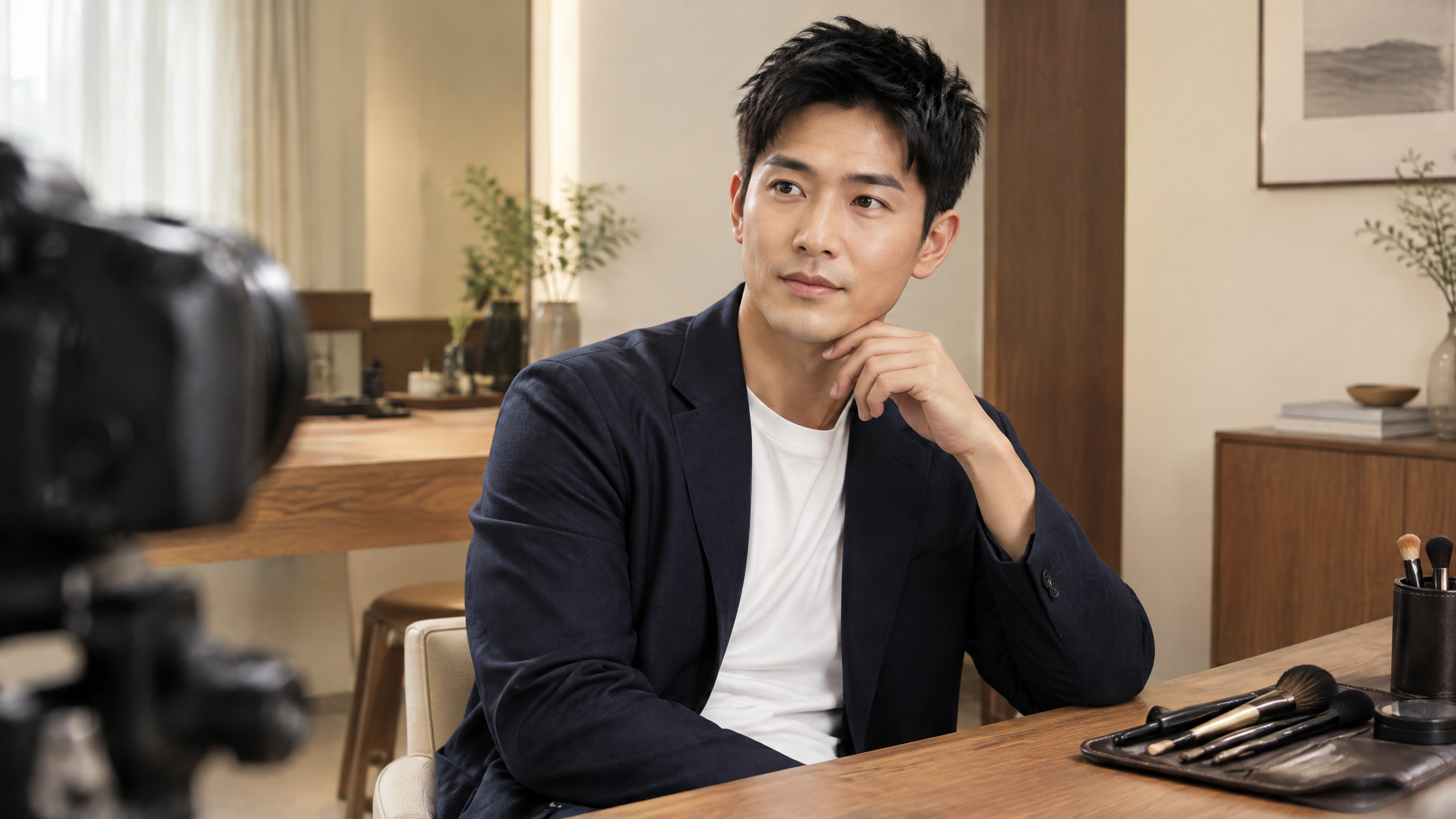
A phrase such as “natural male grooming” can mean a clean, low-shine complexion, a textured crop, a tidy beard, or simply no visible makeup. It is too vague to brief a crew. Begin by describing the image problem: Will the camera move close to the face? Will the subject be speaking? Does the brand want approachable expertise, premium restraint, youthful energy or physical performance? Those answers affect every choice from the hairline to the finish on the forehead.
Separate what must remain from what may change. A recognisable parting, beard shape, glasses, tattoo or mature texture may be part of the subject’s identity and should not be erased accidentally. Conversely, a stray hair crossing an eye, a collar rubbing the neck, or a high-gloss T-zone can distract in a tight shot. Put those priorities in writing so the stylist is solving a visual brief rather than guessing at an idealised version of you.
Give the team the deliverables as well as the hero image. A campaign may need a portrait, three-quarter pose, product demonstration and short interview on the same day. Hair that looks excellent in a still but collapses when you turn your head is not a successful solution. Ask whether the final material includes high-resolution retouching, social crops, subtitles, multiple aspect ratios or long-form video; each increases the value of stable, repeatable grooming.
- State the camera distance, movement and likely lighting in plain language.
- Mark non-negotiable identity details and acceptable changes separately.
- List every planned output, including stills, interviews, vertical edits and close-ups.
- Send current, unfiltered photos from the front, both sides and a three-quarter angle.
02
Translate lighting and lens behaviour into grooming decisions
Lighting does not merely make a face brighter; it reveals different surfaces. A large soft source can make skin look even while a hard or low side light emphasises texture and beard edges. A frontal source may expose shine on the nose and forehead, while a backlight can outline fine flyaways. You do not need to predict the cinematographer’s entire setup, but you should tell the stylist what is known and leave room for on-set adjustment.
For men with short hair, the key trade-off is separation versus visible product. Matte paste, clay or powder can create shape without a wet reflection, but too much product can make the hair look dense, dusty or rigid in a close-up. A low-shine cream may be better when the brief calls for healthy movement. Longer hair needs a decision about whether texture should read as deliberate, loose and touchable, or tightly controlled; those are different finishes, not just different amounts of hairspray.
Facial hair deserves the same precision. Define whether the beard should look freshly lined, naturally grown, softly blended or clean-shaven. A sharp neckline can communicate polish, but an overly dark edge may look graphic under a close lens. If you have a moustache, note whether the mouth must remain clearly visible for speech. Concealing redness around a beard is different from painting over its texture: the former supports an even image, while the latter can make movement and stubble look artificial.
| Camera or lighting condition | Hair and grooming priority | Trade-off to check |
|---|---|---|
| Tight talking-head close-up | Control shine, nose and forehead distraction; keep mouth and beard texture readable | Too much coverage or powder can look flat when speaking |
| Fast movement or product demonstration | Use flexible hold, secure fringe and test turns before rolling | Strong hold may resist movement and look visibly styled |
| Hard side or top light | Check flyaways, uneven edges and beard transitions from the lit side | Over-clean lines can look harsher than intended |
| Soft portrait with premium mood | Preserve natural skin dimension and touchable hair texture | A dewy finish can become unwanted glare in a final close crop |
03
Build a men’s hair brief that a stylist can actually execute
A useful hair brief contains a reference, a starting condition and a boundary. A reference should show the shape and finish you mean, not just a celebrity’s face. Add a sentence such as: “Keep the natural side part, reduce bulk at the temples, leave enough movement for a three-quarter interview, and avoid a wet finish.” This is more actionable than “make it modern.” Include your current length, natural texture, cowlicks, thinning areas, colour history and any products that have caused irritation.
Plan the cut separately from the shoot styling. A substantial haircut immediately before a campaign can introduce an unfamiliar silhouette, redness or a length that no longer matches approved images. If a change is necessary, approve it against the actual wardrobe and lighting rather than a salon mirror. For a maintenance-only session, agree whether the goal is to preserve length, clean the perimeter, soften bulk or simply style what is already there.
Hair preparation is part of the brief too. The right wash state depends on texture, scalp comfort, product buildup and the intended finish. Do not assume that very clean hair is always easier to style, or that skipping a wash is always better. Tell the team what you normally do and ask what arrival condition they prefer. Bring the products you know your scalp tolerates, but do not insist on them if they conflict with the look or continuity plan.
- Reference shape, texture, shine level and movement separately.
- Disclose cowlicks, hairline concerns, thinning, colour treatment and scalp sensitivities.
- Confirm whether the appointment is a cut, a finish, a tidy-up or a continuity reset.
- Take a short test video after styling: speak, turn, look down and return to camera.
04
Make makeup support the message without hiding the man
Camera makeup for men is not a category of face that must be transformed. It is a set of controllable choices: reducing distracting shine, evening visible redness, softening a sudden blemish, defining brows without drawing them on, and keeping lips comfortable under studio light. Ask for the intended finish in visual terms—barely there, clean matte, healthy satin or editorial contrast—and identify where skin texture must remain visible.
Your skin can change during a long day because of heat, nerves, masks, physical movement or repeated touch-ups. A good brief therefore includes the moments when the face will be most visible, not only the first setup. If you will remove a helmet, wipe sweat, eat on camera or demonstrate a skincare product, tell the team before application. The practical solution might be lighter layers, a planned reset or a different approach around the mouth and hairline.
Hygiene is a workflow issue as well as a personal preference. The U.S. Food and Drug Administration advises consumers to wash their hands, keep cosmetic containers clean and closed, and follow label warnings when using cosmetics 1. That is general consumer guidance, not a Hong Kong regulatory endorsement or a certification of any particular provider. On set, you can reasonably ask how cream products are decanted, how applicators are handled and how used items are kept separate.
Eye products require extra caution because a close-up makes small irritation highly visible. FDA guidance says not to share eye cosmetics, to avoid eye cosmetics during an eye infection or inflammation, and to stop using a product if irritation occurs 2. Do not treat a shoot as a reason to push through discomfort. Tell the team promptly, remove the relevant product safely and seek medical advice for persistent symptoms.
05
Brief the production team for continuity, not just one good frame
Continuity means the hairline, parting, beard density, shine level and visible skin finish can be recreated after a break, a wardrobe change or another shooting angle. Take a continuity photograph in the approved setup, record the products or finish in plain terms, and note any deliberate asymmetry. A quick verbal memory such as “a little messy” is not enough when several people must match the look later.
Call sheets should identify the person responsible for grooming decisions and the time when a reset can happen. If you are both talent and client, nominate one decision-maker so the stylist is not receiving conflicting instructions from the photographer, director and brand representative. Share the shot order: a sweaty movement scene before a clean interview may require a different plan from a clean interview followed by action.
A hypothetical planning example: if a team allows 20 minutes for initial grooming, 5 minutes for a continuity photograph and 10 minutes for a reset before a second setup, the planned grooming windows total 35 minutes. That is only an example, not a promised service duration; the actual schedule depends on the people, looks, location and production. The useful habit is to allocate time for correction rather than treating every touch-up as free and instantaneous.
If you need a specialist who is scheduled around a call sheet, continuity, shine control and touch-ups, review film and video makeup Hong Kong as a relevant BigDeal Make Up resource. It is a related-brand reference, not an independent review, and the practical fit, availability and arrangements should be confirmed in writing.
- Create a front, side and three-quarter continuity photo in approved lighting.
- Record the agreed parting, beard edge, shine level and products or tools used.
- Identify reset points around meals, physical action, wardrobe changes and travel.
- Keep one person responsible for final look approval.
06
Choose support according to the production type
A still editorial and a corporate video can both need polished grooming, but their success criteria differ. Fashion imagery may welcome a visible concept, directional texture or an intentionally unusual proportion. A founder interview generally needs consistency across sentences and angles, with hair and skin supporting credibility rather than competing with the message. A product advertisement may require the face and hair to remain stable while hands, packaging and demonstrations take priority.
For a fashion brief, send the mood board, wardrobe changes, crop references and the photographer’s lighting notes. Ask which elements are fixed and which can evolve between looks. If the concept involves wetness, extreme texture or a strong brow, agree how that will be tested under the actual light. A resource describing fashion makeup artist Hong Kong may help you frame that conversation around mood boards, fashion photoshoot makeup and camera-ready styling; it does not replace a project-specific confirmation.
For a commercial or business shoot, prioritise repeatability and communication. Send the call sheet, number of people, speaking requirements, wardrobe notes, venue constraints and the sequence of looks. If several men appear on camera, define whether the goal is identical finish or a consistent level of polish adapted to each face and hair type. The best match is not necessarily the person who promises the most dramatic transformation; it is the support that understands the production’s constraints.
| Shoot type | Send before confirmation | Ask the stylist to solve |
|---|---|---|
| Interview or corporate film | Call sheet, speaking order, camera distance, wardrobe and reset points | Low-distraction shine control, readable mouth and repeatable hair |
| Fashion editorial | Mood board, references, looks, crops and permitted creative changes | Texture, silhouette and concept while preserving movement or continuity |
| Product or advertising content | Product interaction, handoffs, shot list and usage outputs | Stable grooming through demonstrations, close-ups and retakes |
| Portrait campaign | Approved selects, lighting direction, retouching expectations and angles | A finish that holds detail without looking over-corrected |
07
Ask for a useful quote and confirm the boundaries
A quote request should describe the work, not merely ask “how much for makeup?” Include date, call time, location, number of people, number of looks, hair requirements, whether a trial or test is needed, expected finish time, travel considerations and the type of camera work. If the schedule is provisional, label it as provisional. A clear request lets the provider explain what can be supported and what information is still missing.
When comparing responses, compare scope rather than a single number. Does the message cover one look or multiple looks? Is the stylist expected to stay for touch-ups? Are hair and makeup both included? Is there a separate test, assistant or early call? Are location and timing still subject to confirmation? These are decision criteria, not hidden assumptions. Do not infer a fixed rate, booking slot, travel area or service language from a general webpage.
If you want a starting point for a commercial makeup quote, send the call sheet, looks, hours, hair needs, travel, venue and date. BigDeal Make Up is a related-brand resource; commercial makeup rates and the final arrangement remain subject to written confirmation. Treat the quote as a scope conversation, and keep the approved brief attached to the production record.
- Ask what is included, excluded and still awaiting confirmation.
- Confirm who stays for touch-ups and who approves changes on set.
- Keep references, call sheet and final look notes in one shared message or document.
- Do not promise the talent a result that the lighting, schedule or retouching plan cannot support.
08
A final pre-camera checklist for men
On the day, arrive with enough time to be assessed rather than demanding an instant finished look. Wear a top that can be removed without disturbing hair if wardrobe permits, bring glasses or accessories that appear on camera, and disclose any recent shave, facial treatment, sun exposure or reaction. Avoid experimenting with a new active skincare product immediately before the shoot. The aim is predictable skin and hair, not a heroic last-minute fix.
Before the first take, inspect the result at the actual camera distance. Check the hairline, ears, sideburns, beard edge, brows, nose, forehead, lips and collar area. Then move: speak, smile, turn, look down, lift your arms and perform the action required by the script. A still mirror check cannot reveal every issue that appears when hair shifts or light catches a moving face.
Finally, approve the look in terms the team can repeat. Say what is working, name one change at a time, and ask for a continuity image after the adjustment. If the look is intentionally imperfect, define the imperfection: loose fringe, visible stubble, soft texture or a controlled amount of shine. Clear language protects your identity, helps the crew work faster and gives the final images a coherent point of view.
Sources and useful reading
Continue with hair and grooming
Explore the hair-planning side: Business Men's Perm
For another practical image-planning guide: Evening Party Grooming: Hair Texture and Festive Makeup
Meet the lead stylist and learn about the studio: Vit So and Canvas Texture
Plan a camera-ready grooming brief
For a hair consultation at Canvas Texture, share the shoot type, visual references, hair and grooming priorities, schedule and location so the team can discuss a suitable plan. Any service details, timing and arrangements should be confirmed in writing.
Canvas Texture · WhatsAppFrequently asked questions
Should men wear makeup for a commercial shoot?
Not automatically. Camera makeup can be minimal and practical: reducing distracting shine, evening visible redness and keeping the face readable under the planned light. Decide from the shot size, lighting, movement and brand message, then agree how much natural texture should remain.
How should I prepare my hair before the appointment?
Follow the agreed arrival condition rather than guessing. Tell the stylist how recently you washed, what products you use, your natural texture and any scalp sensitivity. Bring current photos and avoid an unapproved major haircut immediately before an important shoot.
What information should I send when requesting on-set grooming support?
Send the date, call time, venue, number of people, looks, hair requirements, camera format or shot type, wardrobe references, action or speaking needs, planned resets and expected finish. Include the call sheet or mood board when available, and ask which details still need written confirmation.
What if my eyes or skin become irritated during makeup?
Tell the stylist immediately and stop using the product that appears to be causing the problem. Do not continue through eye irritation or an active infection for the sake of a take; persistent or significant symptoms should be discussed with a medical professional.
Related journal articles
Camera-Ready Groom: Hair Texture and Natural Makeup
The most camera-ready groom does not look heavily made up; he looks like himself with controlled shine, deliberate hair texture and enough definition to survive changing light. Decide the hair shape first, then use restrained complexion and brow adjustments to support it, and test the complete combination under the kinds of light and movement your day will actually contain.
Wedding Morning Hair and Makeup: A Couple’s Run Sheet
The most reliable wedding morning is not one where everyone starts at the same time; it is one where each person has a clear preparation window, a defined hand-off and enough buffer before the first photograph. Build the run sheet around fixed moments, protect the groom’s haircut and grooming from last-minute experiments, and let the couple prepare in parallel whenever space and suppliers allow.
Bridal Trials and Groom Styling: Test the Whole Wedding Look
The most useful bridal trial is not a bride-only appointment: it is a controlled test of the couple’s complete visual balance. Coordinate the bride’s makeup and hair reference with the groom’s haircut, texture, facial hair and outfit, then judge the result in the lighting and photos you will actually face; this catches proportion, shine and timing problems before the wedding day.

