Natural Hairline Wigs: A Guide to Fringe and Forehead
Natural hairline wigs look most convincing when the front edge, fit, colour, density, and haircut agree. For a hypothetical four-day workweek side part, inspect both temples under two ordinary light sources before choosing a construction. The aim is a coherent outline in movement. No single feature can decide that outcome. Check the whole frame, not only the centre. Check it while turning your head.
That comparison is more useful than assuming that lace, human hair, or price alone creates realism. It separates the front detail you actually show from details hidden by your usual fringe. Treat the result as a personal planning note, not a prediction. It should guide questions about fit, finishing, comfort, and daily effort. It also reveals unnecessary extras. That makes the choice clearer.
This guide explains how fringe and exposed-forehead styles change the decision. It then covers fit, cap zones, colour, density, fitting tests, and custom planning. Two verified health and wig-selection sources provide boundaries for appearance advice. The fitting steps turn broad preferences into observed evidence. They also keep pricing discussions tied to documented needs. Use the final checklist to prepare a Canvas Texture HAIR consultation.
Canvas Texture Editorial · 2026-10-16

What makes a wig hairline look natural?
A natural-looking hairline is a transition, not a perfectly even line. It connects the forehead, temples, hair direction, and the cut around the face. A convincing result needs proportionate density and an edge suited to the style. Judge those elements together in ordinary light. A close front view is useful, but it cannot show how the outline behaves when you move.
Start with the way you normally present your hair. A fringe partly covers the front edge, yet wind or a hand movement can expose it. A side part can reveal one corner more often than the other. Brushed-back hair makes the centre, temples, and sideburn connection more important. The right priority follows those daily movements rather than an idealised product photograph.
Natural hairline describes an appearance rather than one universal cap construction. Lace can soften the visible front transition, while a top structure can help a frequently seen part. Neither term establishes the correct size, shade, density, or cut. Ask which area each feature serves most. Then assess the finished piece in sitting, turning, and looking-down positions before making a decision.
A believable hairline is a relationship between the piece, the haircut, and the moments when you move.
How should men compare fringe and forehead coverage?
A fringe changes which details need the closest inspection. A short textured fringe can soften the central forehead, but the corners may show when it separates. A longer swept fringe gives more coverage, though it may need reshaping after a commute. An open forehead displays the front edge plainly. Compare the style after normal movement rather than only after a careful mirror arrangement.
Check the forehead head-on, then from both diagonals. Move the fringe aside with your fingers and notice whether density suddenly changes behind the edge. Look at each temple where the wig meets the sideburn area. A mismatch can be subtle while still, then more apparent when the hair lifts. This is why a movement test is a better comparison tool than a single posed image.
Use the language of your usual haircut when speaking with a stylist. A low taper, textured crop, and classic side part create different borders around the wig. Bring two ordinary photos that show your preferred finish, not celebrity references alone. Explain whether you usually wear glasses, tuck hair behind an ear, or push a fringe aside. Those habits identify which transition needs the most attention during fitting.
The decision can be reduced to the area others see most often. Prioritise front-edge refinement when you routinely expose the forehead. Prioritise controllable fringe length when coverage is your preference. Prioritise balanced density when the crown feels too full beside a short cut. Writing down that order prevents construction names from distracting you from the visible result you actually need.
| Style | Useful advantage | Question to test |
|---|---|---|
| Textured fringe | Softens the central front outline | Does it separate at the corners after movement? |
| Side-swept fringe | Frames one temple and adds direction | Does the part suit your usual side? |
| Open forehead | Shows the intended hairline clearly | Do the edge and temples remain coherent? |
| Short crop | Keeps everyday styling straightforward | Does density look balanced beside short sides? |
Why do fit and temple transitions matter?
Fit determines where the hairline sits, not whether the cap stays on. A cap that rides upward can expose an unintended edge. One that sits too low can alter the balance of the forehead and eyebrows. Temple placement matters for the same reason. Discuss the forehead, sides, and back instead of relying only on a circumference number. A secure fit should still allow ordinary facial movement.
Wigs can use human hair, synthetic fibre, or a blend. Cancer Research UK notes that photographs and a private fitting can help when choosing. It also notes that price does not guarantee a more natural result. See 1. Use those ideas beside your measurements and styling plan. Ask what care the exact fibre permits instead of assuming that material labels settle every practical question.
Try the piece while sitting as you normally would. Look down, turn each way, raise your eyebrows, and adjust your glasses if you wear them. These actions show whether the front shifts or a temple separates visually. Include facial hair and the intended sideburn finish in the mirror view. Comfort matters as much as appearance, because a sharply defined edge has little value if pressure makes regular wear difficult.
Do not use tightness as evidence that a piece is secure. The American Academy of Dermatology says hairstyles that pull can contribute to traction alopecia, and pain can signal excessive tension. See 2. Stop using any arrangement that causes pain, irritation, or ongoing shedding, and seek medical advice. A salon can discuss visible styling and fit; it cannot diagnose the cause of hair loss.
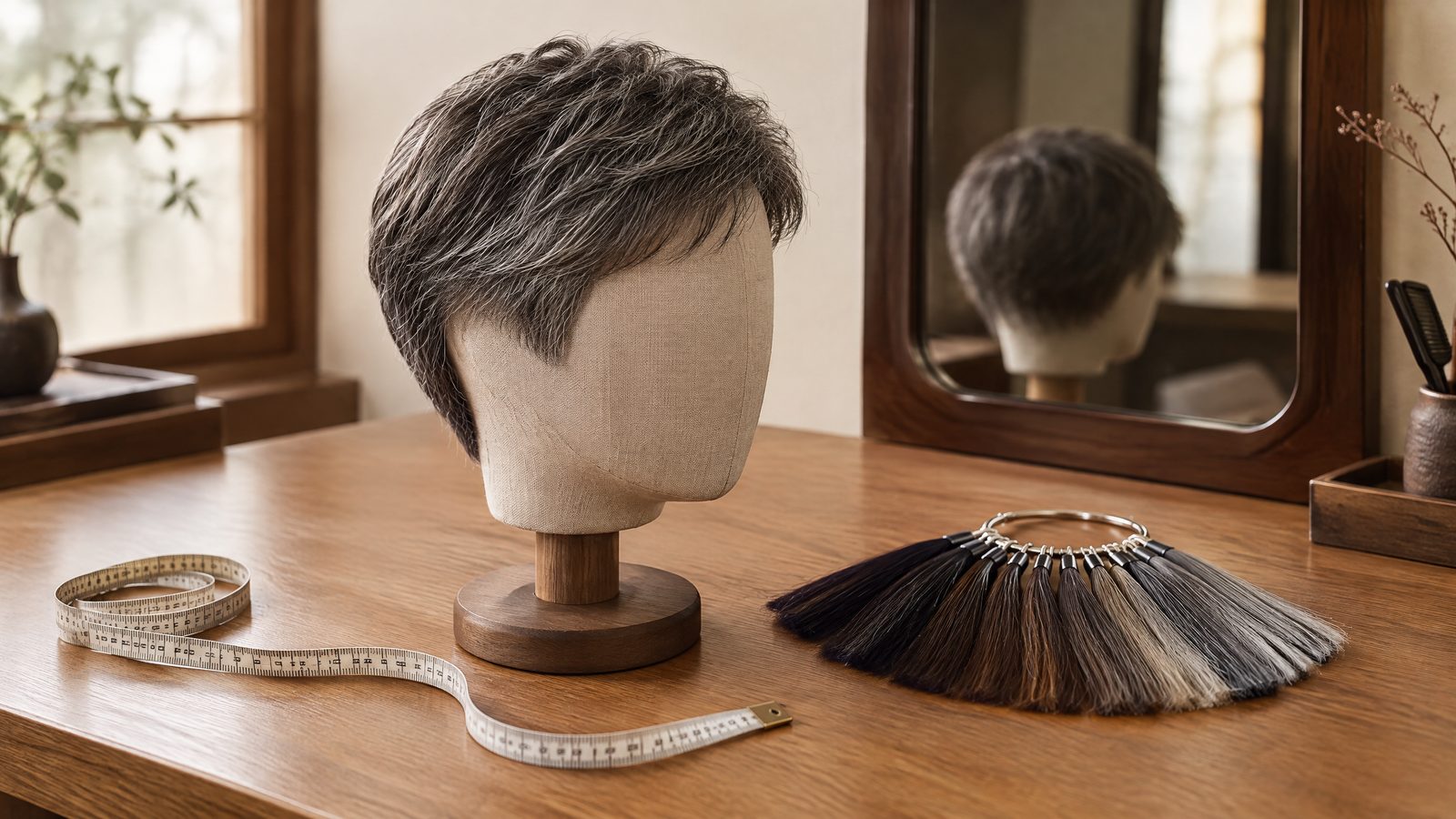
Which cap construction should you compare?
A lace-front construction places lace at the front hairline. A monofilament or similar top structure focuses visual separation at the part or crown. Some caps combine both areas. These labels identify construction zones, not guaranteed results. Ask where lace is used, where hair is attached, and which parting positions remain practical. That conversation prevents a broad category name from replacing a check of the visible areas.
Lace can support a softer-looking front transition when the forehead is exposed. A top structure can matter more when a part or crown is seen regularly. A wearer with a fringe may reasonably put fit and density first. Someone who brushes hair back may place greater value on the front and temples. Neither feature removes the need to examine the final cut on your own head.
Read product descriptions literally. Full-lace coverage does not automatically state density, cap size, attachment method, or comfort. Hand-tied does not automatically mean that every area uses lace. Request a clear explanation of the cap before comparing prices. That approach gives you a decision grounded in confirmed construction and visible need. It avoids assumptions attached to premium-sounding labels. Ask to see the relevant zone.
For a focused explanation of the front zone, see the ownstrand-wigs.com · lace front wig resource. Use it to frame questions about edge visibility and parting, then verify the exact piece separately. The useful distinction is simple: front lace addresses the hairline, while top features address the part or crown. Your everyday style decides whether either area deserves more investment.
How do colour and density affect realism?
Compare colour beside your existing hair, beard, and eyebrows. The darkest black is not automatically the closest match. Undertones, grey proportion, and reflected light can change the result. Bring an unfiltered outdoor photograph, then view samples near a window and under indoor lighting. This gives a more useful comparison than one edited product image. It can also reveal a shade that works in the showroom but not elsewhere.
Density is the amount of hair the finished style appears to have. Extra density can create volume, yet it may look disconnected from short sides or a close taper. Lower density can blend more quietly, though it may restrict fuller styling. Length, texture, and curl change perceived fullness as well. Judge the silhouette after the intended cut, because an untrimmed sample cannot show the final proportions.
Use three checkpoints: hairline, transition, and crown. The hairline should not look isolated from the rest of the style. The transition should not become abruptly thick near the temples. The crown should support the chosen part without looking like a separate mass. If grey blending matters, name the desired proportion clearly. Reviewing all three areas under more than one light produces a decision you can explain.
Ask which adjustments are possible during the finishing appointment. Do not assume every fibre, colour, or construction tolerates the same heat or chemical work. The exact product instructions set those limits. A modest adjustment may preserve the piece and suit the routine better. A dramatic change can add upkeep. Match density and colour to your routine before considering a second styling option.
The most convincing shade is the one that remains credible beside your own features in ordinary light.
What should you check during a fitting?
A fitting is a moving assessment, not a single front-facing photograph. Ask to see the piece from the front, both diagonals, the side, and the crown. Brush the hair forward, sideways, and back. Notice how the edge looks when your expression changes. These checks reveal details that static images hide. They are especially useful when a fringe opens or temples meet the haircut.
Bring accessories that you genuinely use. Glasses can alter the temple line, while a hat or mask can change side pressure. A typical shirt or jacket may also help if the haircut forms part of your work appearance. Note your preferred part, fringe length, and sideburn finish before the appointment. Clear notes distinguish a styling preference from a cap limitation and make the fitting conversation more efficient.
Use a short scoring sheet if you are comparing more than one piece. Rate front edge, temple blend, density, colour, comfort, and daily effort from one to five. The scores are not scientific measurements. They simply show which compromise you are willing to accept. A less refined edge may be preferable when it brings steadier comfort. It may also require less work on ordinary mornings.
For questions about wider lace coverage, review comparing full lace wig options. Treat the page as preparation, not proof that one construction suits everyone. Ask about coverage, attachment, and the part you expect to wear. A fuller construction can broaden styling possibilities. It may add cost or care without improving the area you usually show. Compare this against your normal styling range.
If photographs are allowed, take consistent images from the same distance and height. Do not compare a close phone image with a distant mirror reflection. The purpose is not to eliminate a style because of one angle. It is to identify when the style looks balanced and when it needs adjustment. Comparable images give the stylist a concrete basis for discussing the next fitting step.
- Check the front, both diagonals, each side, and the crown.
- Move the usual fringe or part before judging the edge.
- Record comfort, colour, density, temple blend, and daily effort.
- Confirm care and heat guidance for the exact piece.
How do price and custom planning change the decision?
Custom planning is most useful when your priorities are specific. You may need a particular temple shape, a measured grey blend, or a familiar side part. You may instead value a straightforward ready-to-style finish. State that priority before discussing price. Otherwise, a higher specification can dominate the consultation. It may not answer the visible issue you want to solve today.
OWNSTRAND lists three custom price points. Needle-turn is HK$2,780, full needle-turn is HK$3,280, and Swiss mesh is HK$5,680. These are published custom prices, not a price list for every catalogue item. Ask what the current quotation includes before deciding. The most useful comparison is between a confirmed feature and the situation in which you will actually see that feature.
The published custom process includes viewing samples and measuring the head before the piece is made. It then includes a return fitting with washing, cutting, and blow-drying. The stated production estimate is about three to five working days. That is a making timeframe, not a delivery promise. Raise any event date early, and ask for the current arrangement instead of treating the estimate as a deadline.
Swiss mesh may make sense when an exposed forehead is a regular priority. It may offer little added value to someone who consistently wears a controlled fringe. A lower-priced construction can be the clearer choice when it meets the visible need. Balance the quoted cost against comfort, maintenance, and future adjustments. Price becomes meaningful only after you can name the benefit you expect to see.
| Planning option | Published price | Useful decision question |
|---|---|---|
| Needle-turn | HK$2,780 | Does the base construction meet the visible need? |
| Full needle-turn | HK$3,280 | Does broader custom coverage serve the planned style? |
| Swiss mesh | HK$5,680 | Will an exposed forehead justify the added budget? |
| All custom options | Confirm current quote | What is included in the actual arrangement? |
Where can you get a reliable second comparison?
A second comparison should resolve a different uncertainty, rather than repeat a sales phrase. Compare the edge in another light, ask how the part behaves, or confirm the cap measurement. Each question should narrow a decision. Vague naturalness is difficult to assess, but a visible temple transition or a preferred fringe length can be tested. That shift turns a broad impression into an actionable fitting discussion.
The OWNSTRAND natural-looking wigs guide groups fit, colour, density, hairline, and styling in one comparison framework. Use it to prepare questions for a men's salon consultation. The exact sample and fitting remain the decision evidence. A related-brand guide can describe its approach. It cannot replace your view of the piece in your normal conditions. Use it selectively. Ask specific questions.
A stylist can offer a useful second perspective through haircut logic. Ask whether the silhouette suits your present length and maintenance habits. Ask where the front edge will sit after cutting and whether sideburn blending is needed. Those questions keep the conversation anchored in finish rather than labels. They also make it easier to separate an achievable haircut adjustment from a cap feature that must be confirmed.
Keep medical concerns separate from appearance planning. Pain, irritation, or continuing shedding needs medical attention rather than a styling workaround. A salon can discuss the external appearance of a wig and the comfort of a fitting. It should not diagnose hair loss, promise regrowth, or suggest that a hairpiece treats a medical condition. That boundary protects both a sensible purchase decision and appropriate care.
Begin by identifying your everyday exposure. Is the front edge, a temple, the part, the crown, or overall density most likely to be seen? Next, identify the amount of styling you will realistically do. A more flexible piece may demand more care, while a simpler style can limit the number of looks. That order tells you which feature deserves the closest inspection at a fitting.
Then compare two or three pieces using the same light, movements, and haircut plan. Confirm construction, measurements, care instructions, current price, and production timing for each option. A catalogue number cannot answer all of those questions. The soundest decision has an everyday explanation. Choose the piece that supports your normal morning routine. Do not choose one merely because its label sounds elaborate. That distinction is useful.
For example, a hypothetical office side part could prioritise stable fit and temple continuity. Moderate density and a shade that agrees with facial hair may matter more than dramatic styling range. Test that plan with glasses and a work jacket. This is a planning example, not a claimed customer result. Its purpose is to show how a specific routine produces a practical order of questions.
Perfection from every angle is not a realistic standard. Aim instead for a balanced result that fits your face, routine, budget, and comfort. Good measurement and thoughtful cutting support a natural-looking hairline, but no product label guarantees it. Bring the priorities you have written down to a Canvas Texture HAIR consultation. Confirm final wig specifications, availability, and care directions with OWNSTRAND.
Sources and useful reading
[1] Cancer Research UK — Wigs, hats and scarves
[2] American Academy of Dermatology — Hairstyles that pull can lead to hair loss
Continue reading
Continue with natural hair planning: Korean Men's Perm
Another related decision guide: Human Hair or Synthetic Wigs? Texture and Care Choices
Read our studio background: Vit So and Canvas Texture
Plan your Canvas Texture hair consultation
Bring your usual hairstyle, parting preference, colour questions, and comfort priorities. Canvas Texture can discuss haircut direction and daily styling. Confirm wig fit, cap details, current pricing, care limits, and fitting arrangements separately with OWNSTRAND.
Canvas Texture WhatsAppFrequently asked questions
Are lace-front wigs automatically natural-looking?
No. Lace addresses a front construction area, while fit, density, colour, temples, styling, and lighting still affect the final appearance. Compare the exact piece in motion.
Should men choose a fringe or an exposed forehead?
Choose the style that reflects your ordinary routine. A fringe gives coverage and softness, while an exposed forehead needs closer checking of the front edge and temples.
Can custom wig production take three to five working days?
OWNSTRAND publishes an estimate of about three to five working days for custom production. It is not a delivery promise, so confirm the current arrangement before planning an event.
Can a wig solve a medical hair-loss concern?
A wig can support appearance planning, but it cannot diagnose or treat hair loss. Speak with a doctor about causes, pain, irritation, or ongoing shedding.