Short hairstyles for men with natural waves and curls
A good short cut for natural waves or curls keeps the movement you enjoy where you want to see it. Start with your dry fringe, the width above your ears and the way your crown rests. These details matter more than a haircut name. You can choose a compact shape without automatically choosing a skin fade, a straight fringe or extra chemical texture.
The main trade-off is between visible movement and a closer outline. Taking the sides very short may remove their curls from view. Shortening the top can also change how a bend reads, rather than simply producing a smaller version of your current hair. Decide whether you most value forehead coverage, a soft side connection or a quick morning routine before comparing photographs.
This guide focuses on men's existing natural texture, not creating curls with a perm. It helps you separate the cutting shape from the photographed finish and explain the lengths you need to retain. The useful test is whether you would still enjoy the outline after an ordinary home wash, without recreating every detail of a polished reference image.
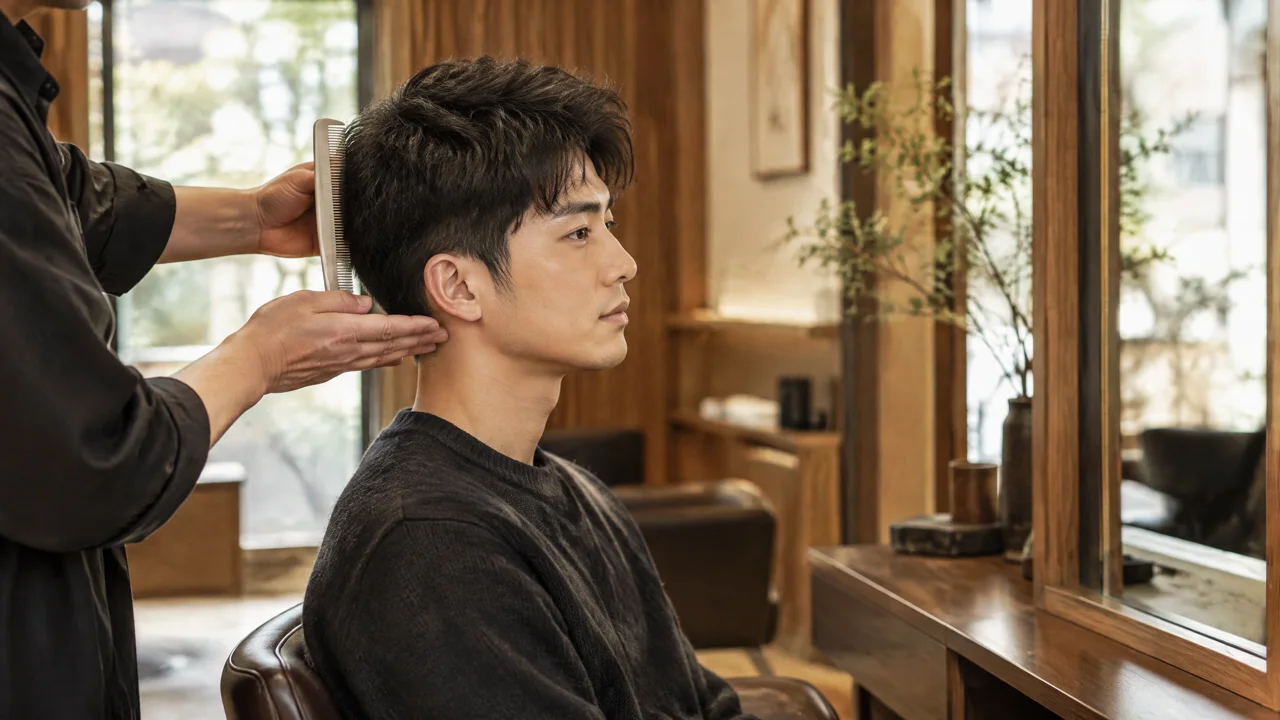
01
Read your dry pattern before choosing a shorter shape
Look at the whole head when the hair is fully dry and resting normally. Loose waves may be clear at the front but barely visible at the crown. Tighter curls may sit differently above each ear. Photograph the front, both sides and back without pulling sections into matching positions. Uneven movement is useful information, not something you need to disguise before a consultation.
Notice where each bend begins, not just where the ends finish. A longer section may show a complete wave, while a much shorter version retains only the part that turns outwards. This does not mean you must keep long hair. It means that a request for shorter waves needs a discussion about which movement will remain visible at the proposed length.
The guide to a haircut for naturally wavy hair explains why ordinary dry movement and retained weight are useful starting points. Its shoulder-length examples are not men's short-cut instructions. For a short style, apply the same observation at the temples, fringe and crown: identify the bend you like, then discuss the outline around it rather than expecting a photograph's texture.
Record when the shape feels awkward. A side that projects immediately after drying raises a different question from hair pressed sideways by glasses or flattened by headwear. For an illustrative example, imagine someone whose right temple only looks wider after removing a cap. That timing belongs in the conversation; asking to thin both sides would overlook the specific change they actually notice.
02
Decide what the fringe needs to do
A fringe is not simply the front portion of the top. It may provide forehead coverage, sweep away from the eyes or supply a small lift. Choose its main job before shortening it. Name a visible boundary such as clear of the glasses or resting near the eyebrows. Say whether you want that position with your ordinary dry texture or only after deliberate styling.
Wet or stretched curls can appear longer than they do when resting dry. The difference can vary across the front, so there is no universal extra allowance to copy from someone else's hair. Show the shortest-looking piece and the longest-looking one. Ask how the proposed front length will be checked against their resting positions before agreeing to a large change.
For a hypothetical office routine, imagine wanting a swept front on weekdays and a relaxed forward fringe at weekends. The useful question is whether the retained length supports both arrangements comfortably. A reference with a crisp part only shows one finish. Explain which version matters most if the two goals compete, instead of assuming that extra product will make either direction effortless.
Also discuss the join between the fringe and the temples. A fuller front beside very close sides can look more prominent even when little top length changes. Keeping some side coverage creates a softer connection, but may leave more width near the glasses. Try to describe the balance you want from the front and side views, not just the fringe in isolation.
The shortest curl is a useful boundary to discuss, not a reason to make every curl the same length.
03
Compare compact cuts by the movement they retain
A forward crop can keep the emphasis on a short fringe and textured top. It deserves consideration if you like movement towards the forehead rather than a lifted finish. Ask where the front should stop when dry and whether the crown should remain softly rounded. A blunt-looking reference edge may rely on arranged strands, so separate that detail from the overall forward direction.
A softly tapered outline keeps more connection between the top and sides than a strongly contrasted close-sided cut. The taper describes the gradual reduction towards the edges, not a promise that every side curl remains. Explain where coverage should stay above the ears and where you want the outline cleaner. The transition matters as much as the shortest point at the nape.
A longer short top can offer room for a relaxed side sweep or a few visible curls. A crew-cut direction retains a compact top with some front shape, whereas a nearly uniform buzz leaves much less movable length. Neither is automatically wrong for textured hair. The choice depends on whether displaying your existing pattern matters more than reducing the amount of hair to arrange.
Use the comparison below to narrow the decision, not to prescribe a cutting length. Two people can choose the same direction and need different retained lengths to show their movement. If you want a dramatic change, identify the feature you would most regret losing first. That might be a front curl, temple coverage or the ability to move the top sideways.
| Direction | Feature to preserve | Trade-off to discuss |
|---|---|---|
| Forward textured crop | A comfortable dry fringe and visible top movement | Less room for sweeping the front backwards if it is cut compactly |
| Soft taper with connected top | Some movement above the ears and a gradual side transition | More side coverage than a close-sided outline; agree where width is acceptable |
| Longer short top with close sides | Front and crown curls or waves | Greater top-to-side contrast and less visible side texture |
| Compact crew-cut direction | A small amount of front shape | Less movable length; the natural fall may differ from a lifted reference |
| Nearly uniform buzz | A deliberately close overall outline | Much less visible wave or curl movement and more exposed head outline |

04
Separate unwanted width from fullness worth keeping
When the sides look broad, describe where the width appears before asking for thinning. You might mean the temple, the area behind the ear or a curl projecting from the crown. These are different concerns. A broad outline can reflect the direction of a few sections as well as the amount of hair present. Making everything lighter does not explain which shape you want instead.
The discussion of curly haircuts for men separates dry length, side coverage and fullness across different curl areas. That is useful when your front already looks separated but the sides feel wide. State what should stay as clearly as what should change: retain the front's substance, discuss the side outline and avoid treating the whole head as equally heavy.
Removing hair and redistributing length are not interchangeable requests. Shorter pieces within a shape can change where fullness sits, while reducing density changes how much hair remains. Ask for an explanation in ordinary language before choosing either. You do not need to name a tool. Saying that you want a narrower temple without a sparse-looking front gives a clearer visual goal.
Consider contrast as well as actual width. In an illustrative scenario, someone likes their rounded curly top but chooses much closer sides from a second photograph. The top may then look larger by comparison, even if its length stays similar. Before combining references, ask whether the stronger contrast is intentional. A gentler transition may better suit someone seeking an understated change rather than a pronounced top.
05
Choose a finish that fits an ordinary morning
Describe your least elaborate routine honestly. Perhaps you let the hair dry, direct the fringe with your fingers or use a dryer before leaving. These are different starting points. Ask which part of the reference comes from the cut and which needs styling. A natural-looking photograph can still involve careful drying, product and individual curl placement that you would not normally repeat.
Do not turn the consultation into a shopping list before the shape is clear. First decide whether you want separated movement, a smoother sweep or a fuller soft outline. Then explain what you already use and what feels uncomfortable, such as stiffness or residue. Ask how much of the desired finish depends on an optional styling step, so skipping it remains an informed choice.
If heat is part of the routine, the American Academy of Dermatology advises limiting heat styling and using low or medium heat settings.[1] This is a gentle-handling reminder, not proof that any particular cut prevents damage. Avoid selecting a daily finish that makes you repeatedly reheat one stubborn section. Ask whether a less exact front arrangement would be acceptable on days when you skip the dryer.
For Hong Kong routines that include outdoor travel, indoor work and headwear, note when the front needs resetting. A deliberate lifted shape may look different after being compressed, while a softer forward outline may be easier for you to rearrange. Neither response is guaranteed. Judge the option against the tools and time you actually have during the day, not only at home.
06
Plan upkeep around the first change you notice
Low morning effort and infrequent trims are separate goals. Close sides can leave little hair to arrange but make changes at the edges important to someone who likes a crisp finish. A softer outline may tolerate a less exact edge, yet retain more hair to dry. Decide which inconvenience bothers you more rather than assuming the shortest option is the easiest in every sense.
Choose a maintenance signal instead of borrowing a fixed timetable. It could be a fringe reaching the glasses, the side outline becoming broader or the nape losing its preferred edge. Different areas may need attention at different times. If you are growing the front while keeping the ears tidy, say that explicitly so a routine tidy-up does not undo the length you want.
After the first home wash, compare the dry front, both sides and crown with the priorities you agreed. Keep the routine familiar so you can describe the change clearly. Notice whether the issue is uncomfortable length, missing coverage or a direction that needs more styling. A photograph taken before correcting everything can be more informative than one showing only the finish you worked to create.
The table turns everyday observations into useful questions rather than diagnoses. If one curl sits differently on a particular day, allow for ordinary variation before deciding the entire cut is wrong. If the same concern keeps returning, record its location and timing. That gives a follow-up discussion something concrete to address without defaulting to a request to remove all the remaining texture.
| Recurring observation | Useful detail to record | Question for the next discussion |
|---|---|---|
| Fringe catches the glasses | Its resting dry position and whether styling changes it | Can the front boundary change while keeping the curl I like? |
| Sides look broader | Whether width begins at the temples or behind the ears | Can that area be adjusted without reducing front fullness? |
| Crown looks awkward after headwear | Before-and-after views with the same routine | Is this a length concern or a finish I need to reset? |
| Ear or nape edge feels untidy | Which edge matters while other areas are growing | Can the perimeter be tidied while preserving the top length? |
A useful maintenance plan names what changes first, rather than promising the haircut will always look freshly finished.
07
Take clear choices into the consultation
Bring one reference for the overall outline and, if needed, another for a specific feature. Label what you like about each rather than asking for both photographs in full. Include your own ordinary dry views. A similar visible wave or curl pattern makes comparison easier, but it still cannot predict an identical result across different density, growth direction or starting length.
When comparing short hairstyles for men, use the retained top's job to organise the options: near-uniform shortness, a small front lift, a side sweep or deliberate upward movement. This keeps the decision focused on what you want to do each morning. You can then add your natural texture and preferred side coverage instead of choosing by style name alone.
Say whether your goal is to reshape existing movement or change the texture itself. Mention previous perming or straightening where relevant, since current lengths may not behave like newer growth. A haircut discussion does not include chemical work by implication. Likewise, showing dry curls is a consultation request, not confirmation that a particular specialist cutting method or certification is available.
Ask how the proposed fringe, sides and crown work together, then check the simplest finish you expect to use. If retaining a particular curl or ear coverage is essential, repeat that priority before shortening begins. Confirm preparation, intended service and appointment arrangements separately. A clear conversation cannot guarantee daily uniformity, but it helps you choose a compromise you understand and can describe afterwards.
- Bring fully dry front, side and back photographs, and state the routine used to create them.
- Name the shortest comfortable fringe position, preferred ear coverage and whether exposed skin at the sides is wanted.
- Identify one area to reduce and one feature to preserve, such as temple width and front fullness.
- Explain your morning tools, headwear habits and the change that normally makes you want another trim.
Sources and useful reading
Continue with hair and grooming
Continue with Canvas Texture’s male hair needs: Korean Men's Perm
Explore another related decision: Men's haircut: how fade and taper change the outline
Read the lead stylist’s background: Vit So and the Canvas Texture studio
Discuss your natural texture with Canvas Texture
Contact Canvas Texture for a consultation about your male hair needs. Share your ordinary dry-hair photos, preferred fringe boundary and the movement you want to retain, so the discussion can focus on a short shape and routine that suit your priorities.
Canvas Texture · WhatsAppFrequently asked questions
Will cutting my hair shorter make it curl more?
A shorter shape can change how existing movement appears, but it does not specify a new curl pattern. It may retain only part of a wave or remove visible side curls. Discuss your own dry pattern and the movement you want to keep rather than expecting extra curls from shortening alone.
Do natural waves need a skin fade to look tidy?
No. A compact top and exposed skin at the sides are separate choices. A softer taper can retain coverage while changing the edge. Explain where you want less width and how much movement should remain above the ears.
Should I arrive with my curls styled or untouched?
Ask what preparation is preferred for the intended consultation or service. Ordinary dry-hair photographs are useful even if arrival instructions differ. Show your usual finish and explain any product, stretching or drying involved; do not create an unfamiliar pattern simply for the appointment.
What if I want short sides but am unsure about losing my curls?
Identify which curls matter to you and where they sit. Compare retained side coverage with a closer option before making a major change. A softer first reduction may be worth discussing, but the appropriate length depends on your current hair and the outline you want.
Related journal articles
Hair salon or hair stylist: what should you compare?
Choose the appointment around the change you need, not the most impressive title on the booking page.
Haircut, wash cut and blow dry: choosing the right family appointment
A family can share a journey to the salon without sharing the same haircut brief.

A layered haircut for busy days: choose what to keep
The most useful length is not always the longest strand; it is the shortest piece your routine still needs.