
A Compact Dive-Day Hair Kit: Less Product, Better Planning
A compact dive-day hair kit needs a clean towel, a way to separate wet belongings and, if your hair needs it, a suitable comb. Small, clearly labelled wash products are optional. The useful starting point is not a shopping list: it is knowing where you can rinse, wash and change after the activity.
For men with cropped hair, a comb might add nothing. A longer fringe, curls or chemically treated lengths may need more considered handling, but not necessarily more bottles. Pack for your actual hair and your journey afterwards. A kit that supports gentle care is more useful than one promising to preserve a perfect hairstyle underwater.
Canvas Texture and DiveHarbour are websites under the same ownership. This is Canvas Texture's men's own-hair grooming guide, not an independent review or diving lesson. We discuss towels, wash planning and low-tension handling here; DiveHarbour should confirm activity arrangements and equipment. The aim is a manageable return to your everyday style, without turning a small outing into a beauty-product expedition.
01
1. Give every item a clear job
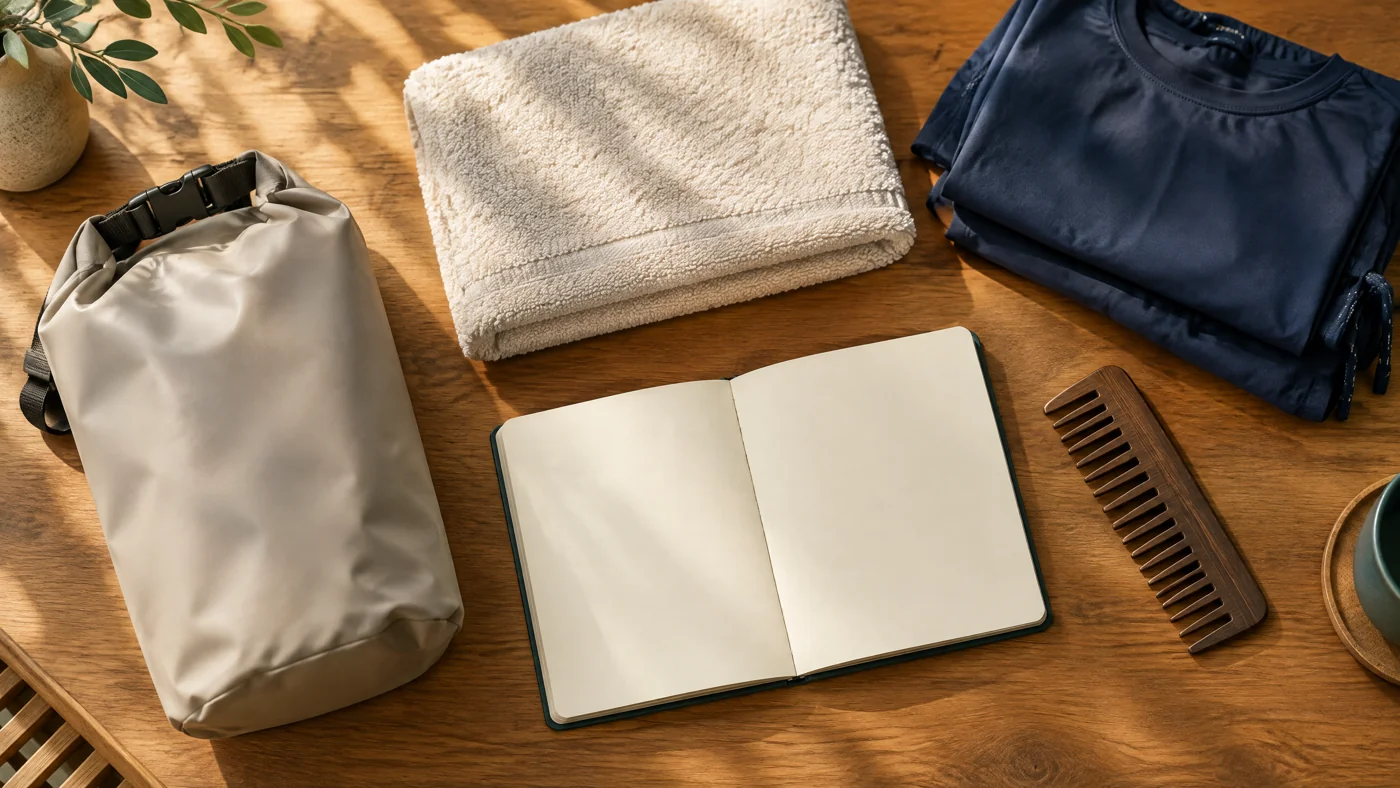
Start by setting out the things you already own. One clean towel is for pressing water from your hair and drying yourself; a separate pouch or bag keeps damp belongings away from clean clothes. A comb, where needed, is for considered detangling ashore. None of these jobs requires a new specialist product just because the day involves water.
Choose a towel that feels comfortable against your scalp and that you will realistically wash and dry afterwards. A compact travel towel saves space, while a familiar soft towel may be easier to use without rubbing. Size matters more than a fashionable fabric claim: an extremely small cloth may leave you searching for something else after changing.
A dry bag can help organise the dry part of your kit, but do not treat its name as a guarantee for valuables. Follow its stated use and ask the organiser about storage. Keep the hair pouch simple and accessible when changing ashore. There is little benefit in packing thoughtfully if your towel is buried beneath everything else.
Separate essential functions from personal preferences. A spare soft hair tie is useful only if your hair is long enough to need one. Styling paste for a later appointment belongs with your dry clothes, not with products intended for washing. Avoid adding a second bottle, brush or spray unless you can explain when you will use it.
- A clean towel that is large enough for your planned use.
- A separate bag or pouch for damp belongings after changing.
- A suitable comb only if your length and texture need one.
- Clearly labelled wash products, only where use is permitted.
- A soft spare tie for longer hair, if relevant to your shore-side routine.
02
2. Match the comb to your hair, not the label
A wide-tooth comb is a practical option for some longer or curlier styles, not a compulsory accessory for every man. Closely cropped hair may only need gentle washing and drying. For a textured fringe, consider whether your fingers can arrange it comfortably after washing rather than carrying a brush that you will barely use.
Length and texture change how you should approach tangles. The American Academy of Dermatology advises different handling for straight and curly hair: straight hair can be allowed to dry somewhat before gentle combing, while textured or tightly curled hair may be combed when damp with a wide-tooth comb. It also advises avoiding towel rubbing and excessive heat [2].
For a longer style, give yourself time to work gently through small areas rather than dragging through the whole head in one stroke. If you encounter resistance, pause instead of pulling harder. Your usual haircut matters here: a fringe that looks short when styled can still have enough length to knot when wet or pushed out of place.
For illustration, a man with a close crop might take no comb, while another with ear-length curls might pack a familiar wide-tooth one. These are hypothetical packing choices, not universal prescriptions. If your hair is bleached, permed or prone to tangling, ask your stylist which handling approach suits its current condition before the outing.
| Hair pattern | Possible compact choice | Question to resolve |
|---|---|---|
| Close crop | No comb if unnecessary | Can washing and gentle drying meet your needs? |
| Longer straight fringe | A familiar gentle comb | When is your hair ready for comfortable combing? |
| Longer curls or textured lengths | A wide-tooth comb if suitable | Does your usual damp-hair routine travel well? |
| Bleached or permed lengths | Tool selected with your stylist | What avoids extra pulling on the current hair condition? |
03
3. Make bottles optional and labels essential
Bring wash products only when you know where you can use them. A familiar shampoo and conditioner may be useful at an approved shower or later at home. They are not a reason to wash in the sea or beside a pool. Check the venue's rules, the product instructions and any organiser requirements before deciding what enters your kit.
If you decant a familiar product, use a suitable travel container and label it clearly with its name and purpose. Retain access to the original directions and ingredients. Identical unmarked bottles are easy to confuse when changing in a hurry. Keep containers closed and separate from the towel so a leak does not leave your drying cloth coated in product.
Do not interpret 'biodegradable', 'natural' or a coastal-looking label as proof that a cosmetic is safe to release into marine water. Permission and suitability still depend on the product and the venue. Nor should hair oil or other cosmetics be used as a gear treatment. Questions about equipment belong with the instructor, not a grooming experiment.
For bleached or coloured hair, more product is not automatically better preparation. The AAD notes that pool chemicals and sun exposure can damage hair and highlights particular concerns around lightening before a sunny swimming holiday [1]. Discuss your existing wash routine and any planned chemical service with your stylist rather than buying a new protective spray on the strength of its packaging.
A clearly labelled bottle you already know is more useful than an unfamiliar promise in travel size.
04
4. Confirm wash access before comparing the day's cost
A smaller kit depends on better information. Before choosing a pool or sea activity, ask whether fresh-water rinsing, showers, changing space and storage are available, and whether you may use your own toiletries. Do not assume that equipment provision includes a towel or access to shampoo. Those details determine what you carry and what you leave for home.
The AAD recommends rinsing hair after swimming and using appropriate shampoo and conditioner for swimming-related care [1]. Plan access to fresh water rather than expecting a tiny bottle to cover a full rinse. If washing must happen later, identify where that will be and leave time for it. Grooming convenience is a planning factor, not a substitute for the organiser's activity arrangements.
When budgeting for an introduction, the discover scuba diving price Hong Kong guide is a useful next read for comparing the proposed format and asking about inclusions. Add your wash-access questions to that enquiry. A headline fee alone does not tell you whether you can change comfortably or return to work with time to reset your hair.
DiveHarbour currently states that all paid fees are non-refundable; make-up sessions are subject to written conditions. Read those terms and obtain the specific arrangements before payment. A convenient hair-washing plan does not create flexibility in the booking. Keep the confirmed inclusions and conditions together so you can decide whether the complete day, including your journey home, suits you.
05
5. Keep styling tension separate from equipment decisions
On an ordinary shore-side morning, avoid building a rigid hairstyle that takes forceful brushing to undo later. A heavily set quiff or tightly pulled longer style can create extra work when you wash. For your dry-land preparation, choose a manageable arrangement that does not tug at the scalp. This is about easing your grooming routine, not prescribing how to wear diving equipment.
If you have a long fringe, longer sides or tied hair, describe that to the instructor before equipment fitting. Ask about hair comfort and suitable equipment rather than changing straps, adding accessories or copying an online workaround. Any swimming cap, mask or hood choice for the activity needs instructor confirmation; a grooming kit cannot promise comfortable contact or a reliable seal.
If you are considering repeated sessions rather than a single outing, the scuba diving course Hong Kong overview can help you frame questions about the learning route and practical arrangements. Include your hair-handling concern in the conversation. For the grooming side, think about a repeatable wash routine between sessions instead of buying several products for one ambitious styling reset.
The instructor confirms eligibility and equipment; a qualified clinician handles health questions. Neither a tidy fringe nor gentle washing changes those responsibilities. Separately, persistent scalp soreness or irritation deserves appropriate clinical advice rather than another cosmetic. Tell your stylist about recent bleaching or perming, too: there is no universal waiting period that guarantees chemically treated hair is ready for a water activity.
Keep the hairstyle comfortable on land, and leave activity equipment decisions with the instructor.
06
6. Build a visitor kit around the return journey
For a visitor, the awkward moment may come after changing rather than during packing. For illustration, imagine leaving accommodation in the morning and having dinner elsewhere later. You need a place for the damp towel, access to the clothes you want afterwards and a realistic opportunity to wash or dry your hair. Carrying extra styling products cannot solve missing access.
The guide to one-day scuba diving for tourists in Hong Kong is a relevant next read when fitting an introduction into a short stay. Ask DiveHarbour about the confirmed meeting arrangements, complete activity duration and storage. Then ask your accommodation separately about facilities you intend to use afterwards. Neither a visitor page nor a hotel location establishes that access for you.
Keep a small dry change separate from the damp kit and allow room for the towel on the return journey. If you expect to style your hair later, put that product with the clean belongings. The separation is practical: it helps you avoid reaching for a damp comb or leaked shampoo when all you wanted was a simple fringe reset.
Choose an easier post-water style if the rest of your day is busy. A relaxed parting or softly arranged curls may be more achievable than rebuilding a high-volume finish without your usual drying tools. Do not plan a precise hairstyle around an unconfirmed finishing time. The useful compromise is a kit and schedule you can actually use, not a promise of looking untouched.
| Return-day situation | Confirm first | Packing consequence |
|---|---|---|
| Using an activity-site shower | Fresh water, toiletries rules and changing access | Take permitted wash products only if needed |
| Washing at accommodation later | Actual access after the activity | Keep familiar wash products there where practical |
| Going elsewhere before accommodation | Where you can change and store damp items | Separate clean clothes from towel and wet belongings |
| Travelling with limited luggage | Storage arrangements for larger bags | Avoid duplicate tools and full-size bottles |
07
7. Finish the routine and learn what to leave out
Once you have suitable washing access, return to the familiar routine that suits your hair rather than layering products in response to every change in texture. Rinse and wash as appropriate, following product directions. Press water out gently with the towel instead of scrubbing. The AAD's damage-prevention guidance supports gentle handling, limited pulling and lower heat when drying [2].
For curls, avoid repeatedly disturbing the shape while trying to make every strand lie flat. For a longer fringe, take the time to detangle appropriately before styling. If you use a dryer, keep the heat low and avoid pulling hard with a brush. A modest finish that feels comfortable is a better target than forcing your normal salon shape back immediately.
At home, empty the damp bag and let the towel and washable accessories dry according to their care instructions. Check travel bottles for leaks and refill only what you used. Notice which item genuinely helped and which stayed untouched. This simple review makes the next kit smaller without relying on a supposedly perfect universal checklist.
Bring those observations to your next styling conversation: whether the fringe tangled, the curls needed a different comb or the cut was difficult to arrange without a dryer. Canvas Texture can discuss men's own-hair styling and everyday care. This article is prepared by the Canvas Texture editorial team with AI assistance and public sources; it does not claim personal testing or a diving-safety endorsement by Vit So.
Sources and useful reading
Continue with hair and grooming
For a separate men’s own-hair discussion: Deep Hair Treatment HK
Continue with a related hair-and-water planning guide: A Visitor’s Fun Dive Day: Leave Space for Hair and Rest
Read our hair styling background: Vit So and the Canvas Texture studio
Ask about a simpler men's own-hair routine
Bring Canvas Texture your questions about your own hair length, texture, fringe and everyday styling after sea or pool days. We can discuss a manageable haircut and grooming routine. DiveHarbour-related activity, eligibility, equipment and booking questions belong with DiveHarbour, not the salon.
Canvas Texture · WhatsAppFrequently asked questions
Does every man need a wide-tooth comb for a water day?
No. A close crop may not need a comb at all. Longer or textured hair may benefit from a suitable wide-tooth comb, but timing and technique should suit your hair. Pack a familiar tool rather than treating one type as essential for everyone.
Is a travel towel better than an ordinary soft towel?
Not automatically. Consider its size, feel, care instructions and how you will dry it afterwards. A smaller towel is useful only if it can do the job without encouraging vigorous rubbing or leaving you without enough drying fabric.
Can I use biodegradable conditioner in the sea?
Do not treat that label as permission or a marine-safety guarantee. Follow the product directions, venue rules and organiser requirements. Plan cosmetic use at a permitted washing facility rather than washing products into the sea.
Can a hair kit protect a fresh perm or bleach service?
It cannot guarantee that result. Ask your stylist about your current hair condition, the products used and the proposed water exposure before scheduling a chemical service. Activity eligibility and equipment remain separate questions for the instructor, with health advice from a clinician where needed.
What if there is no confirmed shower after the activity?
Ask about fresh-water rinsing and arrange an appropriate washing opportunity later. Do not assume you can use accommodation facilities after checkout or toiletries at the venue. Carry a towel and separate damp belongings, but recognise that more bottles will not replace missing wash access.
Related journal articles
First Scuba Lessons: Keep Your Hair, Plan the Pool-Day Wash
Keep the haircut you want to live with; prepare for the wet-hair version of it.

Trying Scuba in Hong Kong: Prepare Your Fringe Before a Mask Fitting
Prepare the fringe you actually have, not the hairstyle you hope will stay unchanged in water.
Choosing a Hong Kong Diving School: A Men's Hair Planning Guide
Choose the learning environment with the instructor; choose an achievable hair routine with your stylist.

