
Choosing a Hong Kong Diving School: A Men's Hair Planning Guide
Choose a diving school by the learning route, instructor confirmation and practical arrangements, not by how polished your hair looks before a session. For men who want to keep their own hair manageable, a second decision matters: can the proposed schedule accommodate sensible washing, gentle drying and the styling demands of the following day? Keep those decisions connected, but give each to the right professional.
A fringe that falls forward, curls that knot easily or recently lightened lengths can make preparation feel complicated. You do not need a drastic haircut to begin asking useful questions. Describe your everyday hair concerns to your stylist, then ask the instructor about equipment suitability and session arrangements. Neither conversation replaces the other, and a convenient wash routine does not establish fitness to dive.
Canvas Texture and DiveHarbour share the same website owner. This is a planning guide, not an independent school ranking or a claim that salon expertise extends to diving safety. Prepared by the Canvas Texture editorial team with AI assistance and public sources, it helps you build a decision worksheet that respects your hair, your time and the limits of styling advice.
01
1. Give each decision to the right professional
Start your worksheet with two columns: questions about learning, and questions about hair. The instructor confirms course eligibility, current requirements, equipment and the proposed environment. Your stylist can discuss your existing cut, chemical-service history and everyday handling. A clinician handles individual health questions. Splitting these responsibilities prevents an appealing hairstyle or a familiar business name from becoming an accidental safety endorsement.
Make your hair description specific enough to be useful. Say whether the fringe reaches your eyebrows, whether the back tangles when wet, or whether you normally need a hot dryer to create volume. These are practical grooming observations, not reasons to diagnose a problem. Ask your stylist which parts of the routine can be simplified without changing the character of the cut.
If you want a provider's own account of its learning options, DiveHarbour's Hong Kong diving school overview is a relevant next read. Use it to prepare questions about the person teaching, the applicable training organisation and the arrangements that need confirmation. It is provider information, not evidence that one school outranks every alternative or that a particular programme suits you.
Keep unresolved answers visible rather than filling the gaps yourself. An instructor's pending equipment decision should stay pending; your stylist should not turn it into a cap or haircut recommendation. Likewise, a course enquiry cannot decide whether your lightened hair is ready for another chemical service. Separate answers make it easier to act on reliable information instead of convenient assumptions.
| Question | Who should answer? | What to record |
|---|---|---|
| Which course matches my starting point? | DiveHarbour instructor | Current prerequisites and proposed learning route |
| Can my fringe be easier to manage? | Men's hairstylist | Options for the existing cut and daily routine |
| Does the proposed equipment suit me? | DiveHarbour instructor | Equipment confirmation and a chance to discuss hair concerns ashore |
| Does a health concern need assessment? | Appropriate clinician | Individual advice and any required documentation |
| Can I attend another chemical service? | Hairstylist, using product guidance and hair assessment | A service plan separate from activity eligibility |
02
2. Describe your hair before choosing a shorter cut
A shorter style is not automatically the best water-activity style. It may make washing quicker, yet leave a fringe that still drops forwards or a shape that needs more daily styling than expected. Judge a proposed change by ordinary life as well as the course day. You still need to like the cut at work, at home and between appointments.
For straight hair, discuss how the front sits without its usual product. For curls, discuss shrinkage, knots and the time needed for gentle detangling. For longer hair, ask about a low-tension arrangement away from equipment, with the instructor confirming what is appropriate for the session. These descriptions are more useful than asking for a universal diving haircut that cannot account for individual equipment or hair.
Avoid pulling hair tightly just to make it look neat. The American Academy of Dermatology recommends gentle handling and avoiding unnecessary pulling; it also distinguishes combing approaches for straight and curly hair.[2] A stylist can help translate those general principles into a routine for your texture. Comfort is useful feedback, but it does not certify the suitability of a hairstyle around diving equipment.
A hypothetical office worker with a textured fringe might keep the same length but ask for an easier everyday finish. Another man with longer curls might prefer no cut at all, focusing instead on calmer wash-day handling. Neither choice is a safety solution. Take the resulting hair concerns to the instructor before the session rather than experimenting with equipment or tension in the water.
An easier haircut should simplify your ordinary week, not promise to solve an equipment question.
03
3. Compare the learning commitment with your actual week
Your available time includes more than the advertised learning activity. Travel, changing, washing and drying all compete with the next commitment. Ask for the proposed attendance pattern and meeting arrangements, then place your normal hair routine alongside them. Someone who takes time to detangle curls should not build the same turnaround plan as someone with a short cut that dries easily.
When comparing a full qualification pathway with an introductory experience, ask what each option actually involves and which suits your starting point. DiveHarbour's scuba certification course Hong Kong guide offers a useful basis for that conversation. Confirm the agency, teaching language, assessment and attendance requirements directly. A shorter commitment or a convenient location does not make different learning routes interchangeable.
Consider a hypothetical man who has an important presentation the morning after a proposed session. If his usual finish depends on lengthy drying and several styling stages, that timing deserves attention. He could ask about alternative arrangements before committing, or plan a simpler look with his stylist. He should not choose a less suitable course purely to preserve his preferred hairstyle.
Record which parts of the schedule are confirmed and which remain conditional. A place name on a website is not proof of a branch, a shower facility or a fixed departure. Ask about changing facilities and freshwater access rather than assuming they exist. If the answer changes your hair-care plan, revise the plan before treating the day as compatible with work or social arrangements.
04
4. Discuss fringes, curls and equipment without improvising
Equipment concerns are worth raising early, even when they seem cosmetic. Tell the instructor if wet hair frequently falls across your face, tangles at the back or feels uncomfortable when held away from your face. Ask for an appropriate opportunity ashore to discuss suitability. The aim is to make the concern known, not to prescribe how equipment should be fitted or altered.
Bring your everyday hair description rather than a solution bought from a social-media post. A swimming cap and a diving hood are not interchangeable assumptions, and neither should be selected by a salon as a substitute for instructor confirmation. Do not modify a mask, change its strap or apply oil or grease to solve a hair concern. Appearance is not a reason to improvise with equipment.
There is also no need to arrive with a heavily sculpted finish just to look prepared. Consider whether your normal product leaves hair difficult to wash or requires extra handling afterwards. Your stylist can suggest a simpler shore-side routine for your own hair. Any product use must follow its directions and the venue's rules; a salon recommendation does not establish compatibility with equipment.
Keep the conversation practical: describe the hair issue, ask who will review it, and note the answer. If something feels uncomfortable during the activity, tell the instructor rather than trying to preserve a hairstyle. Later, tell your stylist what was difficult about washing or detangling. That feedback can inform grooming changes without turning a salon visit into an equipment assessment.
05
5. Plan the wash, not just the photograph
The most useful grooming question may be where you can rinse afterwards. The American Academy of Dermatology notes that pool chemicals and sun exposure can damage hair and recommends rinsing after swimming, with suitable washing and conditioning.[1] That advice supports planning access to freshwater; it does not promise that any routine prevents all damage. Confirm the facilities and permitted products before packing.
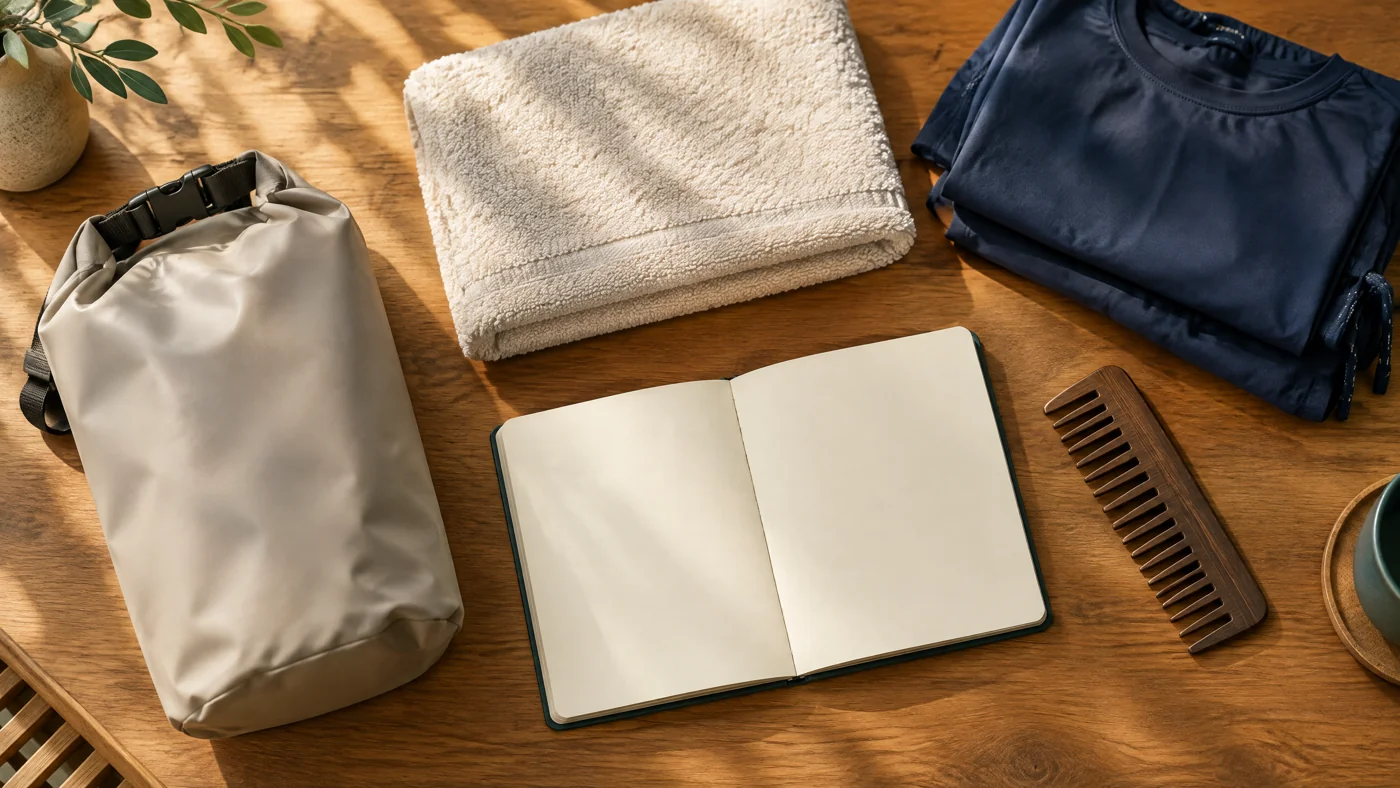
Build a compact wash kit around products you already tolerate, rather than making the course day a product trial. A towel, a suitable comb and clearly closed toiletries may be enough for your normal routine. Keep cosmetic use on shore and follow both product instructions and venue rules. Labels such as biodegradable do not by themselves establish marine safety or permission to use a product near water.
After washing, handle hair gently instead of rubbing it briskly to save time. The Academy advises against towel rubbing and recommends limiting heat and choosing a low heat setting when drying.[2] Combing should suit your texture rather than follow one rule for every man. A curl routine may need a different approach from a straight fringe, so agree that approach with your stylist beforehand.
The table below organises wash logistics, not treatment. Adjust it to the facilities you have confirmed and your existing routine. If there is no convenient place to finish styling, allow for a simpler appearance on the journey home. Persistent scalp discomfort belongs with an appropriate clinician; stronger shampoo, repeated scrubbing or a new haircut should not be presented as medical care.
| Planning point | Practical hair question | Useful preparation |
|---|---|---|
| Before leaving home | Can I simplify my usual finish? | Use a familiar routine that does not depend on preserving a sculpted look |
| Before confirming attendance | Where can I rinse and change? | Ask about freshwater, changing facilities and product rules |
| After the activity | How will I handle wet lengths gently? | Bring a towel and a comb suited to the agreed routine |
| Before the journey home | Is there a suitable place to dry my hair? | Allow time or plan a simpler finish without relying on unconfirmed facilities |
| Before the next workday | Which styling steps are genuinely necessary? | Choose an achievable everyday look rather than a rushed full restyle |
06
6. Put chemical services and payment terms on the same calendar
If you are considering colour, lightening or a perm, tell your stylist about the proposed pool or sea plans before scheduling the service. The Academy highlights potential hair damage from summer exposure and advises considering the trade-off around lightening before a sunny swimming holiday.[1] That is a reason for an individual consultation, not a blanket ban or a universal waiting period.
Do not use a fixed number of hours after a chemical service as proof that entering the water is suitable. Product guidance, hair condition and the specific service belong in the stylist's assessment. Course eligibility and equipment remain separate instructor questions, while health concerns belong with a clinician. It may be simpler to reconsider the service date than to force two uncertain plans together.
Before you book a scuba diving course in Hong Kong, review the proposed arrangement and written terms alongside those grooming commitments. DiveHarbour currently states that all paid fees are non-refundable, with make-up sessions subject to written conditions. Do not assume a salon appointment clash, unexpected scalp discomfort or a missed session creates a refund or an automatic replacement date.
Budget for the practical day without inventing a standard package. Ask DiveHarbour to confirm current inclusions and any additional charges, then consider your own travel and grooming needs. A modest wash kit may be more useful than a last-minute chemical service chosen for photographs. Keep the quotation and terms together so that decisions rest on written information rather than optimistic expectations.
A tidy calendar is more useful than a promised waiting period: confirm the service, the session and the terms separately.

07
7. Turn the worksheet into two clear conversations
Finish by writing two short messages rather than one overloaded request. For your stylist, describe your current cut, texture, chemical history and the time you can realistically spend washing and styling. Include what you want to preserve: perhaps curl definition, a fringe shape or a tidy profile for work. This gives the salon a genuine grooming brief without asking it to approve a water activity.
For DiveHarbour, provide your starting point, learning goal, preferred dates and questions about facilities or hair-related equipment concerns. The instructor can confirm the applicable requirements and explain the next step. Complete required health information honestly through the appropriate process. Do not send a stylist's reassurance as medical evidence, and do not ask an instructor or salon to make a clinician's decision.
When replies arrive, look for unanswered questions rather than a perfect promotional description. You need enough information to understand the learning arrangement and an achievable way to care for your own hair. If one part remains unclear, pause that decision and ask again. A provider's photograph, a polished hairstyle or shared ownership cannot fill in missing confirmation about your individual situation.
After the outing, note what affected your ordinary routine: slow drying, difficult knots or a finish that needed too much effort. Use those observations to improve the next haircut discussion, not to draw conclusions about diving safety. The successful styling outcome is practical and personal: hair you can handle gently, with a look you enjoy on the days when you are nowhere near water.
- Describe one specific hair concern instead of requesting a universal diving haircut.
- Ask the instructor to confirm eligibility, equipment and the proposed arrangements.
- Check freshwater access, changing facilities and permitted cosmetic use.
- Read non-refundable fee and make-up conditions before paying.
- Keep salon styling advice, instructor confirmation and clinical advice distinct.
Sources and useful reading
Continue with hair and grooming
For a separate men’s own-hair discussion: Deep Hair Treatment HK
Continue with a related hair-and-water planning guide: Hong Kong Island Lessons: Towels, Dry Clothes and the Commute
Read our hair styling background: Vit So and the Canvas Texture studio
Make your own hair easier to manage
Ask Canvas Texture about men's own-hair cuts, texture and everyday styling that fit your routine. Bring questions about your fringe, curls or wash-day handling. DiveHarbour-related activity, course and equipment questions belong with DiveHarbour; individual health questions belong with an appropriate clinician.
Canvas Texture · WhatsAppFrequently asked questions
Do I need to cut my hair short before choosing a diving school?
Not automatically. Discuss the manageability of your existing cut with your stylist, including the fringe and wet tangles. The instructor must separately confirm equipment suitability. A shorter haircut is not evidence of diving eligibility.
Can Canvas Texture confirm that my hair works with diving equipment?
Canvas Texture can discuss men's own-hair styling and gentle everyday handling. Equipment suitability belongs with the instructor. A salon cannot promise mask fit or approve a cap, hood or equipment alteration.
What should I ask about pool or sea wash facilities?
Ask whether freshwater rinsing and changing facilities are available, what toiletries are permitted and whether there is a suitable place to dry your hair. Do not assume a location page confirms those facilities.
Is there one waiting period after a perm or colour service?
This guide does not give a universal waiting period. Ask your stylist to assess the service, product guidance and hair condition. Discuss activity eligibility with the instructor and individual health concerns with an appropriate clinician.
Will changing a hair appointment let me move a paid course session?
Do not assume so. DiveHarbour currently states that all paid fees are non-refundable. Make-up sessions depend on written conditions, and a preferred replacement date is not guaranteed. Read the applicable terms before payment.
Related journal articles
First Scuba Lessons: Keep Your Hair, Plan the Pool-Day Wash
Keep the haircut you want to live with; prepare for the wet-hair version of it.
Trying Scuba in Hong Kong: Prepare Your Fringe Before a Mask Fitting
Prepare the fringe you actually have, not the hairstyle you hope will stay unchanged in water.
PADI eLearning and Men’s Haircare: Plan Study Time Around Pool Days
Flexible theory is useful when it creates breathing room around water days, not when it hides the time needed afterwards.

