Advanced Diving Plans: A Multi-Day Wash Routine for Men’s Curls
For several wet days, build a repeatable hair routine around fresh-water rinsing, suitable washing and gentle drying, rather than repeatedly recreating your usual hairstyle. Keep the training calendar separate: an advanced course title does not certify your readiness, and a proposed schedule is not a guaranteed completion date. Your hair plan should still work if sessions move or the programme changes.
For men with curls, a perm or a longer fringe, the practical challenge is often cumulative handling. One wet day might involve a rinse, a shower and some detangling. Repeating that pattern can mean unnecessary combing and restyling unless you decide which steps actually help. A modest, comfortable shape is a more useful goal than perfect definition after every session.
Canvas Texture and DiveHarbour share a website owner. Prepared by Canvas Texture’s editorial team with AI assistance and public sources, this guide concerns men’s own-hair care and lifestyle planning, not diving instruction. DiveHarbour should confirm course eligibility, equipment and activity arrangements; a clinician handles health questions. Keeping those responsibilities separate makes your planning clearer.
01
1. Keep the course calendar and the wash calendar separate
Start with two lists. One records the training arrangements that the provider has actually confirmed. The other records your likely access to a shower, a clean towel and somewhere to dry your hair. Do not translate a course name into a fixed number of consecutive wet days. Sessions may be distributed differently, and any change affects how much hair-care kit you need and when you can comfortably return to your normal morning routine.
For the training outline, the Advanced Open Water Diver course Hong Kong page is a related next read. Ask DiveHarbour which agency route is proposed, whether your certification and recent experience meet its requirements, and what remains provisional. A course title is not a personal assessment of competence. For your hair diary, note only the confirmed water sessions; leave other dates open rather than planning chemical services or important photographs around an assumed finish.
A useful haircut for this period is one you can leave relatively unstyled. That does not automatically mean cutting everything short. A longer top may settle adequately without deliberate lift, while a fringe that depends on careful blow-drying may need a different everyday finish. Discuss your actual wash habits with your stylist. Ask for a shape that tolerates an imperfect morning, not a promise that a haircut will solve equipment fit or make any activity suitable.
02
2. Establish your normal hair condition before changing anything
Before the first planned wet day, look at your hair after an ordinary wash using familiar products. Notice where tangles form, whether the ends feel rough and whether your scalp is comfortable. Those observations give you something concrete to compare later. A naturally loose curl pattern, for example, should not be judged against a tightly styled salon finish. Knowing your baseline helps you avoid treating every flattened curl as a problem that needs another wash or more product.
If you have recently coloured, bleached or permed your hair, ask your stylist about the products used and your present hair condition before committing to repeated exposure. There is no universal waiting period that guarantees a new chemical service is ready for the sea or pool. Consider postponing an optional service when your routine is already demanding. The salon can discuss hair condition and styling trade-offs; the instructor must separately confirm the proposed activity and equipment arrangements.
Pack a small set of familiar essentials rather than a trial collection. You need enough to rinse, wash when appropriate, condition according to the product directions and dry gently. Decant only into suitable, labelled containers so you can recognise each item with wet hands. Check venue rules before taking or applying cosmetics. A biodegradable label does not establish that a formula is harmless to marine life or permitted in a pool, and hair products should not become improvised equipment treatments.
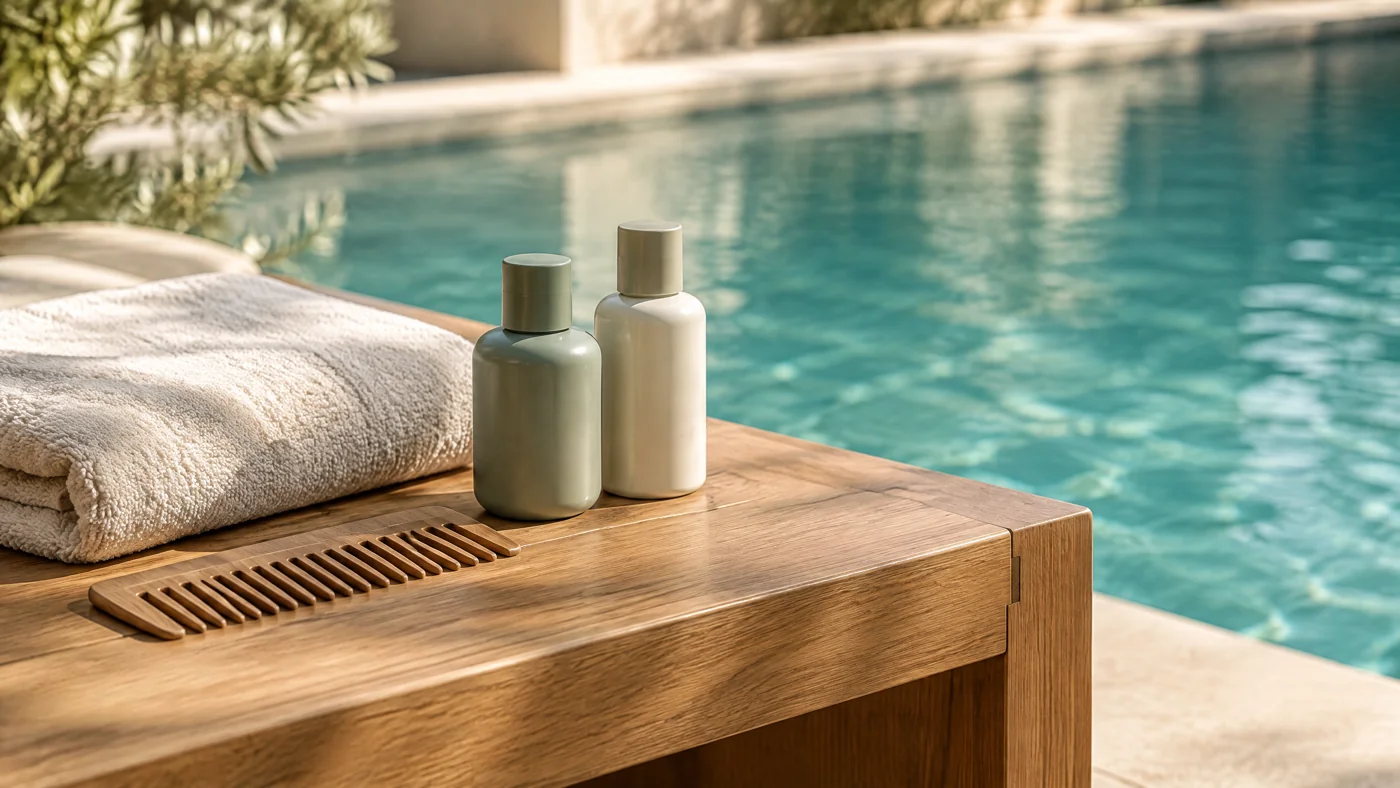
- Pack a clean towel that you can use by pressing rather than rubbing.
- Take your usual suitable shampoo and conditioner in clearly labelled containers.
- Bring a comb only if it suits your hair texture and normal detangling routine.
- Keep a separate bag for damp items so tomorrow’s clean towel stays dry.
- Confirm where cosmetic use and fresh-water washing are permitted.
A familiar, modest routine is easier to adjust than a bag full of products you have never used.
03
3. Distinguish a fresh-water rinse from another complete wash
The American Academy of Dermatology notes that pool chemicals can damage hair and recommends rinsing after swimming, with suitable cleansing and conditioning as part of care.[1] Make access to fresh water a planning question rather than an assumption. If you expect several wet periods, ask where you can rinse once ashore. Do not substitute extra styling product for that basic opportunity, or assume a quick rinse will always remove everything that needs washing from your scalp and hair.
A rinse and a shampoo serve different purposes. Decide on cleansing from your hair and scalp condition, product directions and the exposure involved, rather than automatically repeating your entire routine every time your fringe gets wet. If your usual wash leaves your hair comfortable, it is a useful starting point. Resist adding an unfamiliar intensive cleansing step merely because you are on a water-focused trip. Repeatedly changing products makes it harder to identify what is leaving the ends rough or the scalp uncomfortable.
For curls, use conditioner as directed and avoid trying to force the finished shape while the hair is still tangled. Work patiently in manageable portions using the approach that suits your texture. The table below separates common observations from reasonable hair-care responses; it is not a diagnosis. If washing becomes painful or irritation continues, stop experimenting with stronger products and seek appropriate clinical advice. Hair care after swimming does not treat hair loss or establish whether you are fit to dive.
| What you notice | Useful response ashore | What to avoid |
|---|---|---|
| Hair has been exposed to pool water | Use the available fresh-water rinse and suitable wash care | Assuming more styling cream replaces rinsing |
| Hair feels coated by styling products | Follow your familiar cleanser’s directions and assess the result | Layering new products over the coating |
| Curled ends are tangled | Condition and detangle gently using a texture-appropriate approach | Forcing a comb through resistance |
| Scalp discomfort persists | Seek appropriate clinical advice instead of escalating products | Treating pain as a normal styling inconvenience |
04
4. Protect curls from repeated handling, not just water exposure
The American Academy of Dermatology advises gentle handling, avoiding towel rubbing and limiting heat; it also distinguishes between detangling approaches for straight hair and textured or tightly curled hair.[2] That distinction matters for men who usually brush a short fringe quickly but now have a longer, permed top. Do not transfer the same forceful brushing habit to a different texture. Ask your stylist to demonstrate an approach appropriate to your hair, including how damp it should be when you work through tangles.
Press out moisture with a towel rather than scrubbing the scalp and lengths together. Handle a difficult patch separately instead of dragging through the whole top repeatedly. Once it is organised, let the shape remain simple. Constantly touching, separating and recoiling every curl can turn a short drying session into prolonged handling. You do not need a perfectly uniform pattern to look presentable; a soft, less defined finish may be the more practical choice between closely spaced wet days.
Hair containment around diving equipment is a separate conversation. Tell the instructor ashore if your fringe, tied hair or usual accessories seem likely to cause interference or pulling. Ask them to confirm suitable equipment and hair handling rather than inventing a tighter tie or altering a mask strap. Do not apply oil or grease to gear, and do not assume a swimming cap can replace required head protection. No hairstyle guarantees a seal; a comfortable salon arrangement is not an equipment assessment.
05
5. Budget for washing access and drying time as well as training
Course fees are only one part of deciding whether a multi-day plan fits your week. You also need to know whether you can reach a permitted washing area and get home without rushing straight into another commitment. For current training costs, use the Hong Kong AOW diving course price page as the next read, then request a written breakdown. Do not assume the course quote answers questions about shower facilities, towels, transport or where you can use your own products.
DiveHarbour currently states that all paid fees are non-refundable. Make-up sessions are only subject to its written conditions, not an automatic right to another date. Read those conditions before paying, and distinguish course arrangements from any separate travel plans. For hair planning, avoid treating a possible make-up date as a certainty when booking a perm or colour appointment. Flexible grooming arrangements cannot fix inflexible payment terms, and a changed water session does not itself promise either a refund or convenient rescheduling.
Drying time is also a real scheduling need, even if you prefer not to use heat. In a hypothetical plan with a wet session before an evening engagement, a relaxed hairstyle and an unhurried wash may matter more than carrying extra styling tools. Ask about facilities rather than assuming a hairdryer or private changing area exists. If those answers are unclear, simplify the evening plan or choose a different date. The aim is a manageable day, not fitting every task into an optimistic timetable.
| Planning issue | Question to resolve | Why it matters for your hair routine |
|---|---|---|
| Confirmed water sessions | Which dates and locations are confirmed in writing? | You can pack for actual wet days rather than an assumed course duration |
| Washing facilities | Where is fresh-water washing available and what products are permitted? | You can plan appropriate rinsing and cleansing without inventing facilities |
| Return journey | What meeting and finishing arrangements should you allow for? | You can leave realistic time for washing and gentle drying afterwards |
| Changes or missed sessions | What do the written make-up conditions allow? | You can avoid tying a chemical service appointment to an uncertain date |
06
6. Use brief curl notes to adjust the next wet day
Keep the notes short enough to use. In a hypothetical diary, an entry might say: fresh-water rinse available, usual shampoo used, ends tangled near the fringe, scalp comfortable, towel pressed rather than rubbed. Another might record that a heavy styling product was difficult to wash out. These are observations, not evidence that one product prevents damage. Record what you actually used and how you handled the hair, so you can change one unnecessary step rather than replacing the entire routine overnight.
Before the next planned wet day, look for a practical pattern. If the same small area keeps tangling, ask whether your detangling technique or everyday styling needs adjustment. If the shape merely looks flatter, you may not need additional cleansing. Choose the lowest dryer heat that is practical when heat is needed, and avoid pulling the hair taut to rebuild volume.[2] Leave ambitious styling for a day when you have time; the repeatable finish is the useful one during a run of wet sessions.
Persistent scalp irritation, sores or unexpected shedding should not become entries that you simply learn to ignore. A stylist can discuss visible hair condition and your grooming habits, but a clinician should address ongoing symptoms. Separately, report activity-related concerns to DiveHarbour and follow any required health assessment process. Do not use a comfortable scalp, neat curls or a successful rinse as evidence that you are ready for the next training session. Hair observations help manage hair; they cannot approve participation.
Record the step that made tomorrow easier, not whether every curl looked identical.

07
7. Choose progression that leaves room for ordinary life
If your schedule is already crowded, compare learning formats before committing to another block of wet days. The advanced diver training Hong Kong guide is a useful next read for discussing a broad programme, a focused interest or a review of existing skills. DiveHarbour must confirm which route is appropriate for your experience and the current requirements. Your contribution is an honest account of available time, recent activity and practical constraints, including how you will manage washing between sessions.
For grooming, progression may simply mean learning to wear your existing curls with less product and less tension. You do not need a new perm to make a water-focused week feel planned. A stylist can help you decide whether your fringe needs reshaping, whether a lighter everyday finish suits the cut, or whether an optional colour change should wait. Make that choice from your own hair condition and maintenance preferences, not from the prestige of a course name or an imagined photograph afterwards.
Finish with two clear enquiries. Tell Canvas Texture what your natural or chemically treated hair is like, how often you expect it to get wet and what daily finish you can realistically maintain. Send course, equipment, venue and activity questions directly to DiveHarbour. Keep health questions with an appropriate clinician. With those conversations separated, your multi-day plan can stay useful even when dates change: manageable hair, sensible washing access and training decisions made by the people responsible for them.
Sources and useful reading
Continue with hair and grooming
For a separate men’s own-hair discussion: Deep Hair Treatment HK
Continue with a related hair-and-water planning guide: SSI Weekends and Perm Care: Leave Room for Cleaning
Read our hair styling background: Vit So and the Canvas Texture studio
Make your own hair easier to manage between wet days
Ask Canvas Texture about a men’s own-hair cut, curl shape or everyday styling routine that fits your washing habits. Bring questions about your fringe, texture and preferred level of maintenance. DiveHarbour-related activity and course questions belong directly with DiveHarbour; Canvas Texture does not book diving sessions or provide medical advice.
Canvas Texture · WhatsAppFrequently asked questions
Do I need to shampoo after every individual wet period?
Do not create a rigid repeat-wash rule. Plan fresh-water rinsing after swimming and suitable cleansing and conditioning for the exposure, your scalp condition and product directions. Repeated scalp discomfort needs appropriate clinical advice, not stronger or more frequent products.
Does an advanced course always mean consecutive wet days?
No fixed sequence should be assumed from the name. Ask DiveHarbour to confirm the proposed agency route, sessions and arrangements. Eligibility, conditions and progress can affect the plan; a preferred completion date is not a guarantee.
Can I perm my hair just before a multi-day water plan?
Ask your stylist about your hair condition and the chemical products involved. There is no universal waiting period that guarantees suitability for sea or pool exposure. Discuss activity and equipment suitability separately with the instructor, and health concerns with a clinician.
Should I add oil to prevent my hair catching in equipment?
Do not use cosmetics as equipment treatments or put oil or grease on gear. Raise hair interference and pulling with the instructor ashore so they can confirm suitable arrangements. Product and venue rules still apply to ordinary hair care.
Can Canvas Texture arrange my course or assess my readiness?
No. Canvas Texture can discuss men’s own-hair styling and daily care. DiveHarbour handles its activity enquiries, eligibility and equipment arrangements. A clinician handles health assessment. Shared website ownership does not merge those responsibilities.
Related journal articles
First Scuba Lessons: Keep Your Hair, Plan the Pool-Day Wash
Keep the haircut you want to live with; prepare for the wet-hair version of it.

Trying Scuba in Hong Kong: Prepare Your Fringe Before a Mask Fitting
Prepare the fringe you actually have, not the hairstyle you hope will stay unchanged in water.
Choosing a Hong Kong Diving School: A Men's Hair Planning Guide
Choose the learning environment with the instructor; choose an achievable hair routine with your stylist.