Grey Wigs: Choosing a Mixed Colour or Custom Percentage
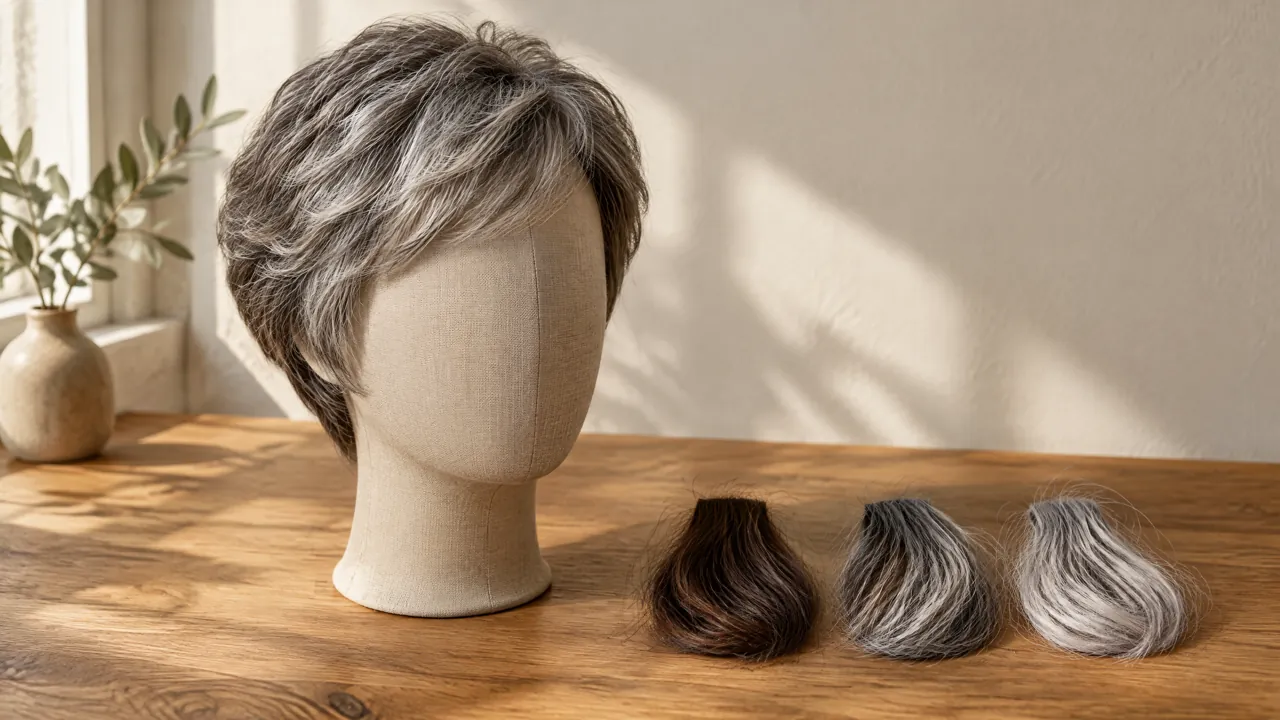
Choose a grey blend by its base shade, placement and relationship to your remaining hair, not by a percentage alone. A custom percentage is worth exploring when an available blend misses a specific feature you want to preserve. Start with the outline you recognise: the sideburns, temple colour, parting and overall shape. Those details give a clearer comparison than deciding that a larger amount of white must look more natural.
The available shade information distinguishes grey, silver and white descriptions, while the custom service invites enquiries about matching and available choices. These are starting points, not confirmation that every percentage or colour arrangement can be supplied. Compare a physical sample where possible, ask what its colour description means, and check the material and care instructions. A convincing photograph alone cannot establish how the blend will sit beside your own hair.
For readers of Canvas Texture, this is also an outline question: which familiar features should stay visible when coverage changes? Your answer might favour a darker crown, lighter temples or simply the same restrained silhouette. OwnStrand is a related brand under the same ownership, not an independent recommendation from this website. This guide separates colour decisions from fitting and styling decisions so you can make a focused enquiry without treating a new piece as an automatic improvement.
01
1. Identify the dark base before comparing the grey
Two blends with a similar apparent amount of pale hair can create different impressions if their darker strands differ. A soft brown background and a much darker background do not frame a face in the same way. First describe the darker colour beside your ears and at the back, if that hair will remain visible. Then decide whether your aim is continuity with those areas or a deliberate change across the whole style.
The shade guide for grey wigs introduces grey, silver and white descriptions. Use it to organise your questions, rather than assuming those names define a precise blend. Ask which sample or product corresponds to the description, and whether its darker base and lighter strands can be viewed together. Availability and individual specifications still need confirmation. A colour name is useful for narrowing a conversation, but it is not a substitute for examining the proposed piece.
Make a small comparison sheet with three entries: your visible darker hair, your visible pale hair and the finish you want overall. Avoid editing the reference image to brighten the whites or deepen the dark areas. If you regularly colour your remaining hair, note whether the reference shows it freshly coloured or after some fading. Otherwise, you may approve a blend that matches one brief stage of your routine but feels disconnected later.
02
2. Map where the pale strands belong in your outline
After identifying the base, look at distribution. Your temples may be lighter than your crown, or a pale patch may be more noticeable on one side. An evenly mixed sample may therefore seem unfamiliar even when its overall lightness feels close. Use a front photograph and two side photographs to mark the areas you want to retain. This is a visual reference for discussion, not a promise that every marked zone can be reproduced.
Placement matters most at boundaries where the piece meets visible hair. Check the sideburn area, the hair above the ears and the back edge before concentrating on the crown. A close colour match can still look abrupt if the lengths or direction change sharply at that boundary. Conversely, a modest shade difference may be acceptable when the shape connects smoothly. Decide which boundary will be most exposed in your usual haircut rather than demanding identical colour everywhere.
Consider an illustrative scenario: someone has pale temples, darker hair at the back and a compact, swept outline. Increasing pale strands across the whole crown might create a different identity rather than restore the familiar look. That person could instead ask whether a darker overall blend with lighter side areas is feasible. If it is not, an available blend plus a revised outline may be a more practical choice than insisting on a numerical target.
Colour feels familiar when its placement agrees with the shape around it.
03
3. Compare samples under repeatable viewing conditions
Use a simple viewing sequence rather than collecting unrelated screenshots. Start in indirect daylight, move to ordinary indoor lighting, then step back to a normal conversational distance. Avoid judging only under a bright overhead spotlight or through a phone filter. Keep the background and your position similar when comparing candidates. The aim is not to find a universally perfect light, but to see whether your preference remains stable across the conditions you actually encounter.
Take notes before taking more photographs. Write down whether a candidate looks too light overall, too dark at the edge or simply unfamiliar near your face. Camera exposure can change when a bright window or dark shirt enters the frame, so images should support your observations rather than overrule them. Compare with your remaining hair in the same setting. A photograph taken elsewhere may suggest a useful direction, but it cannot settle a close colour decision.
The table below gives each viewing condition a separate job. Do not average every impression into a percentage; identify the mismatch and ask whether it concerns colour, placement or outline. If your preferred sample changes completely between settings, pause before ordering. You may need another sample, better references or a clearer understanding of the proposed material. Repeating a controlled comparison is more useful than adding increasingly precise numbers to an uncertain description.
| Viewing condition | Question to answer | Decision if the result is poor |
|---|---|---|
| Indirect daylight beside visible hair | Does the darker base connect with my own hair? | Compare another base shade before changing the pale proportion. |
| Ordinary indoor lighting | Does the blend still feel comfortably grey rather than unexpectedly bright or dark? | Request another sample view; do not approve from daylight alone. |
| Conversational distance, front and side | Does the colour placement support the familiar outline? | Review placement and cutting shape rather than only the colour label. |
04
4. Turn a percentage request into a usable custom brief
A percentage needs a shared definition before it becomes useful. Ask how the supplier describes the proportion, what reference demonstrates it and whether it applies throughout the piece or to specified areas. Do not assume a universal counting method across sellers. Numbers can sound precise while leaving the most visible details unresolved. An enquiry for a particular proportion should therefore include the darker base, the pale tone and the distribution you are trying to achieve.
The service page for a custom wig with a percentage of grey hair describes discussion of natural blends, available choices and colour matching by enquiry. It does not establish that every exact percentage, zone pattern or fibre combination is available. Send your reference photographs with a short priority list and ask which elements can be confirmed. If a requested detail cannot be reproduced, ask what alternative sample or arrangement would be closest before deciding whether to proceed.
Separate essentials from preferences in that brief. For example, continuity at the exposed side edge may be essential, while a lighter crown may be negotiable. Ask what will be approved before production and what alteration options exist afterwards; do not assume a custom order remains freely changeable. An existing blend may be the sensible choice if it already meets your main priorities. Customisation earns its place when it resolves a specific mismatch, not merely because it sounds more personal.
| Your comparison result | Next route to investigate | Trade-off to clarify |
|---|---|---|
| An available sample matches the base and exposed edges | Ask about that specific model and its availability | Less scope to change distribution, but a concrete sample to assess. |
| The base works, but an important pale zone is missing | Ask whether a custom arrangement is feasible | Additional decisions and approval terms, without assuming exact reproduction. |
| Neither the base nor the pale tone is convincing | Request better colour references before specifying a percentage | A slower comparison now may prevent an unsuitable custom brief. |
05
5. Check what the pale strands are made from
Colour and material are separate questions. Ask what fibres make up the proposed piece, including the pale strands, rather than inferring composition from a photograph or a broad product category. Clarify whether the colour is natural, processed or achieved through a blend, where the supplier can confirm this. A general material label does not answer every question about a particular grey mixture. Record the model and the written description so later care advice relates to the same item.
Cancer Research UK distinguishes synthetic, human-hair and mixed options, and advises checking manufacturer guidance before applying heat to synthetic pieces.[1] This is useful shopping guidance, not an endorsement of a supplier. If you want to change the direction or wave, ask what styling methods the proposed item permits. Do not carry over your usual hairdryer or heated-tool routine without checking. A familiar shape is only practical if its permitted maintenance fits the time and skills you have.
Ask whether the darker and lighter portions require any different precautions, and what products are recommended for the exact item. Do not presume that household colour treatments or your usual toning shampoo are suitable. Establish who can advise on colour changes before planning to make them yourself. The trade-off is straightforward: a blend that looks excellent initially may be a poor choice if maintaining its finish requires a routine you are unlikely to follow consistently.
06
6. Test the outline as well as the colour
Once a colour candidate is credible, assess its shape from the side and back. Check whether the front height, crown fullness and length above the ears match your intended style. Grey colour does not compensate for excessive bulk or an unfamiliar hairline shape. Compare with a photograph of an outline you genuinely like, rather than one chosen only for its shade. Cancer Research UK also suggests bringing older photographs to help communicate a familiar hairstyle.[1]
Discuss colour approval separately from fitting and cutting approval. Ask which features are adjustable, which are fixed and when the final outline would be assessed. If a fitting is available, use ordinary head movements to judge comfort and visible edges, following the fitter's instructions. Do not accept discomfort as evidence of a secure fit. Where your remaining hair will stay visible, ask how the proposed lengths would connect without assuming that all pieces offer the same construction or adjustment options.
Keep a written record of the agreed model, composition, colour reference, included work and transaction terms. The Hong Kong Consumer Council's consumer-protection guidance identifies misleading and incomplete goods or service information as a concern.[2] That supports asking precise questions; it does not guarantee an unconditional return right. Confirm any deposit, cancellation and alteration conditions before committing. An attractive sample should not leave you guessing which details belong to the actual order or what happens if your expectations differ.
Approve the colour you can describe and the outline you can recognise, not a number you cannot verify.
07
7. Make the final choice around your daily routine
Before choosing, picture an ordinary morning rather than a special occasion. Will the intended parting, side shape and pale placement still work when you have limited styling time? Which parts of your own hair will remain visible between haircuts? Decide how much contrast you can comfortably accept and which change would feel distracting. If the answer depends on constant correction, reconsider the blend or silhouette. A manageable compromise is often preferable to a fragile match that requires ideal conditions.
For further material comparison, the page on human hair wigs points readers towards hair type, care labels and fit, with styles and availability to be confirmed. Use those categories to compare your shortlisted colour option with your routine. Human hair is not an automatic guarantee of the right grey tone or an effortless result. Ask for item-specific answers about composition and care before treating the material category as the deciding factor in your purchase.
Finish with a one-page brief: reference images, the chosen base, essential pale areas, the intended outline and the questions still unanswered. Review it before any order rather than relying on memory from a conversation. If the colour is settled but the shape is not, keep those decisions separate. Canvas Texture's role here is guidance on men's own-hair styling and familiar outlines, not wig sales or fitting. You can preserve that styling perspective while making product enquiries directly with the relevant supplier.
- Choose one reference photograph that best represents the outline you want to retain.
- Name the exposed edge where colour continuity matters most.
- List the material, maintenance and approval details that still need confirmation.
- Keep the agreed product description and transaction terms together before ordering.
Sources and useful reading
Continue with hair and grooming
If your question concerns styling your own men’s hair, continue with: Men's Perm for Fine Soft Hair
Compare a related selection decision: Human hair wigs: preserve a familiar mature outline
Read our male-hair styling background: Vit So and the Canvas Texture studio
Clarify the outline you want to keep
Ask Canvas Texture about men's own-hair styling and the side shape, crown balance or everyday finish you want to preserve. Bring a reference photograph to keep the consultation focused on your original hair and a manageable styling routine.
Canvas Texture · WhatsAppFrequently asked questions
Does a higher percentage of pale hair always look more natural?
No. The darker base, pale tone, distribution and outline all affect the impression. More pale hair may suit your reference, or it may create an unwanted change. Compare a sample beside any hair that will remain visible.
Can I order an exact match from a photograph?
A photograph can communicate direction, but lighting and camera exposure affect colour. Ask which sample or written specification will define the order, what can be reproduced and how approval works. Do not assume photographic similarity guarantees an exact match.
Should I choose customisation if an existing blend looks close?
Identify what 'close' leaves unresolved. If the exposed edges and overall tone already work, an existing option may meet your needs. Customisation is worth investigating for a specific important mismatch, subject to feasibility and confirmed terms.
Can I use my normal toning products on the pale strands?
Do not assume so. Confirm the item's fibre composition and care instructions, then ask about the specific product you intend to use. Advice for your own hair may not apply to a processed or mixed-fibre piece.
Related journal articles
Men’s Hairpieces or a Perm? Compare Coverage and Shape
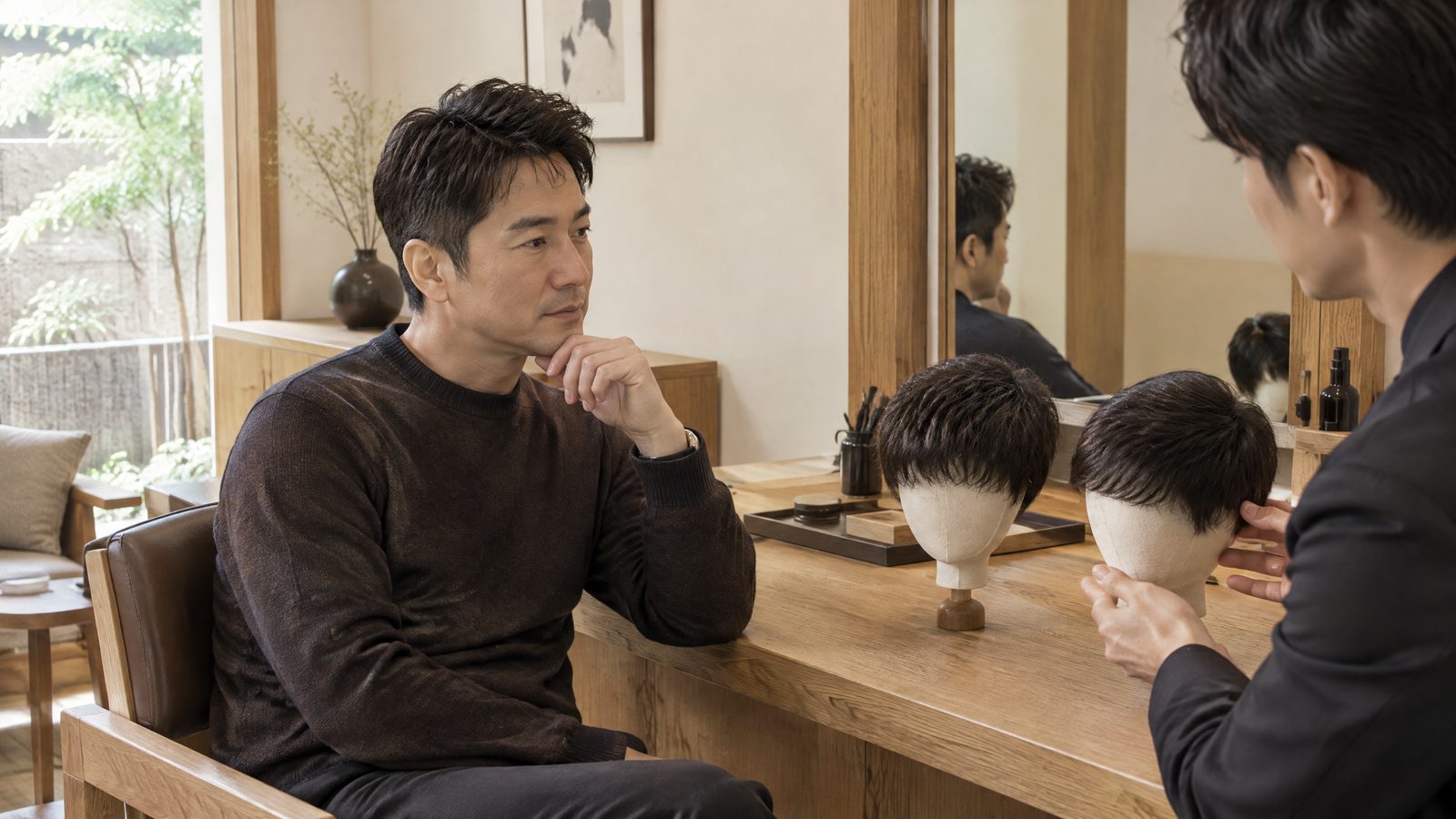
Choose a perm when enough existing hair remains and movement is the main goal. Choose a hairpiece when a defined area needs cosmetic coverage. Neither option decides the best outline by itself. First identify the visible area, surrounding density, preferred parting, and morning routine. Those observations prevent a product label from making the decision too early. Compare those details before making any booking.
Natural Hairline Wigs: A Guide to Fringe and Forehead
Natural hairline wigs look most convincing when the front edge, fit, colour, density, and haircut agree. For a hypothetical four-day workweek side part, inspect both temples under two ordinary light sources before choosing a construction. The aim is a coherent outline in movement. No single feature can decide that outcome. Check the whole frame, not only the centre. Check it while turning your head.
Human Hair or Synthetic Wigs? Texture and Care Choices
Choose human hair when approved styling flexibility matters. Choose synthetic fibre when a preset shape and simpler mornings matter more. Neither label settles the result alone. Texture, density, cap construction, attachment, and fit shape how a wig looks and feels. Start with the routine you can maintain, then check the exact model’s instructions. That order avoids paying for flexibility you will not use