Halloween Hair and Makeup: Design, SFX and Removal Planning
A strong Halloween look is designed from the hairline outward, not painted on as an afterthought. Decide the character, movement, lighting, contact points and removal method before choosing colour or prosthetic effects; that approach keeps your grooming intentional and makes a dramatic look easier to wear safely.
01
Start with the character, not the product
The fastest way to make a Halloween style look considered is to define one visual idea in a sentence: perhaps a sharply controlled vampire with a wet-looking side part, a scarred nightclub demon with a broken fringe, or a monochrome ghost whose hair supplies the only texture. That sentence becomes a filter for every decision. If the character is elegant, a random spray of glitter may weaken it; if the character is distressed, an immaculate blow-dry can look more like a costume mistake than deliberate contrast. Men’s grooming gives you useful structure because the cut, hairline, beard shape and eyebrows already establish the face’s geometry.
Before buying anything, make a simple coverage map. Mark what belongs on hair, forehead, cheeks, lips, neck, ears and exposed body, then note which areas will touch a collar, helmet, glasses, mask or another person. A design that looks excellent in a still reference can fail when a high collar rubs a painted jaw or when a fringe drops onto wet cream makeup. If you need a professional conversation, a Halloween makeup artist Hong Kong brief is more useful when it includes the reference image, venue, clothing, schedule and the exact parts of your face or hair that must remain mobile.
Treat the reference image as a direction rather than a promise. Face shape, hair density, facial hair and available preparation time change the result, so identify the non-negotiables: silhouette, dominant colour, one focal effect and the mood visible at the expected distance. A club audience may read a bold brow and hair outline while missing fine skin texture. A small dinner may reward restraint. This hierarchy also prevents a common failure in men’s Halloween grooming: adding more product whenever the first idea does not read clearly. More layers can create weight, shine and transfer without improving recognition.
- Write the character in one sentence and choose one focal feature.
- Photograph your hair at the length and texture you will actually wear.
- List every contact point: collar, hat, glasses, mask, hands and pillow.
- Choose a finish—matte, oily, wet, dusty or metallic—before selecting products.
02
Build the hair silhouette before adding colour
Hair is the frame that makes face paint legible, especially in photographs. Start with shape: height at the crown, direction at the part, width at the temples and the outline around the ears and neck. A controlled pompadour, severe centre part, narrow slick-back or deliberately uneven crop can signal a character before any SFX work begins. If your hair is short, texture powder or a firm styling product can create separation; if it is longer, pinning or temporary extensions may be more reliable than repeatedly coating the roots. Test the structure with your costume on, because a hood, lapel or shoulder line changes the apparent proportion of the head.
Temporary colour should be selected for the real surface, not just the shade shown on a can. Dark hair may need a lighter or more opaque product to show; bleached or porous hair may hold pigment and feel dry after removal. Sprays can transfer to pale collars, while waxes can alter the hair’s movement and leave a visible residue. Keep colour away from eyes, lips and broken skin, and follow the product label rather than improvising with household paint. A dramatic silhouette with one deliberate colour zone usually photographs better than several muddy tones competing with a detailed face.
Facial hair deserves its own plan. A beard can ground a monster design, but it can also trap cream products and make a clean prosthetic edge difficult. Decide whether the beard is part of the character, a texture to be toned down, or a boundary that the makeup should avoid. For a polished villain, outline and groom the beard before makeup; for an undead look, uneven texture can be intentional, but it should still be placed rather than accidental. Avoid changing a familiar facial-hair shape minutes before leaving: rushed shaving can irritate skin and remove the visual anchor that made the reference work.
| Desired effect | Hair approach | Main trade-off |
|---|---|---|
| Graphic, elegant character | Clean part, controlled shine, defined edges | Needs touch-ups if humidity breaks the finish |
| Wild or supernatural character | Backcombing, separated texture, temporary colour accents | More tangling and a longer wash-out |
| Minimal face makeup with strong identity | High-contrast silhouette or unusual fringe direction | The cut and shape carry most of the design |
| Covered or helmeted character | Low-profile styling and secure, flat sections | Less visible hair means the face and costume must do more work |
03
Separate everyday makeup from SFX decisions
Everyday makeup and special-effects makeup solve different problems. Everyday products refine tone, shadow and feature definition; SFX materials create a raised edge, altered surface, false wound, bruise impression or body-paint pattern. Decide which illusion you actually need before adding a material. A carefully placed shadow may communicate a hollow cheek with less discomfort and easier removal than a built-up appliance. Conversely, a three-dimensional effect will read better at close range when the edge, texture and colour transition are planned rather than simulated with a dark pencil.
For a scar, wound or creature texture, record three details in advance: the exact body area, the expected coverage, and how it will come off. That information matters for clothing, movement and skin tolerance. A SFX makeup for Halloween Hong Kong enquiry should therefore state whether the design is face-only, extends onto the neck or arms, and whether glasses, facial hair or a costume edge will cross it. Ask what the proposed materials are intended for, what preparation they require and what removal steps are expected; do not assume that a reference image reveals those constraints.
Keep the illusion readable by controlling contrast. A raised effect needs a believable boundary, while a flat painted effect needs directional shading that agrees with the venue’s light. Warm restaurant lighting, coloured club lights and phone flash all change skin tones. Make a small test on paper or a hidden area of the costume to check colour transfer, then take a front-facing and side-facing photo in lighting similar to the event. This is not about chasing perfection; it is a practical way to catch a design whose strongest detail disappears when your head turns.
- Use flat colour and shading when comfort and fast removal matter most.
- Reserve raised materials for a feature that benefits from texture or close viewing.
- State the coverage map and contact points before committing to an SFX design.
- Do not use a product on the eye area or broken skin unless its label and intended use support it.
04
Plan hygiene and skin tolerance as part of the design
Safety is a design constraint, not a footnote. Wash your hands before touching products, keep containers closed and clean, and do not share makeup, brushes or applicators. The US Food and Drug Administration’s consumer guidance says to follow label warnings, keep cosmetic containers clean and stop using a product that causes a problem; it also notes that terms such as “hypoallergenic” or “natural” do not guarantee that a product will suit everyone 1. This is general US consumer guidance, not Hong Kong law or a certification of any particular service.
A patch test can be a sensible planning step when the product label permits it, but it is not a guarantee that a full application will be comfortable. Consider the length of wear, heat, sweat, shaving, friction and the location of the design. Freshly shaved skin can feel more reactive, while heavy beard stubble can make adhesive edges lift. Avoid building a complicated look over irritation, active rash or damaged skin. If something stings, burns or causes an unexpected reaction, remove it according to the product guidance and seek medical advice for persistent or serious symptoms rather than trying to cover the sensation with another layer.
Eye products need a stricter boundary. Do not share them, do not improvise with a lip pencil as eyeliner, and do not use saliva to revive dried mascara. FDA eye-cosmetic guidance advises avoiding cosmetics when the eye is infected or inflamed, stopping if irritation occurs and seeking medical care if discomfort continues 2. It also warns against applying eye makeup in a moving vehicle. For a costume, that means doing the detailed eye work while stationary, with clean tools and enough light to see what you are doing.
| Check | Ask yourself | Action if the answer is no |
|---|---|---|
| Skin condition | Is the intended area calm and intact? | Simplify, move the design or postpone it |
| Tool hygiene | Are hands, brushes and containers clean and personal? | Wash, replace or do not share |
| Eye area | Is the product intended for this use and can I apply it while still? | Keep it outside the eye area or wait |
| Wearability | Can I move, sweat and remove it without rubbing hard? | Reduce coverage or change the material plan |
05
Make the venue and schedule work for you
A Halloween look has to survive a real evening, not just a bathroom mirror. Check whether the venue is outdoors, air-conditioned, crowded, humid or likely to involve dancing. Heat and friction can soften styling products and encourage a hand to the face. A costume with a high neckline can catch hair colour and rub the jaw; a mask can disturb nose makeup; glasses can create pressure marks through a painted temple. Build the design around those realities. Matte, simplified areas often last more gracefully than a thick shine that becomes patchy, while a secured fringe may be more useful than a fashionable loose strand that repeatedly falls into the eyes.
Work backwards from the time you must be dressed, and label any arithmetic as a hypothetical planning example. For instance, if a look hypothetically needs 25 minutes for hair, 55 minutes for makeup, 15 minutes for drying or setting and 10 minutes for a final costume check, the preparation block is 105 minutes. Add travel and a buffer separately rather than pretending the application time includes traffic. This calculation is not a promised service duration; it is simply a way to protect the last part of the process, when people are most tempted to skip hand-washing, eye checks or careful removal instructions.
Pack a small repair kit that matches the design: clean tissues, a comb, the labelled touch-up product, cotton swabs, a mirror and a sealable bag for used items. Do not take an unlabelled liquid or decant a product into a container you cannot identify. If a piece begins to lift, remove it safely or cover the boundary with a deliberate design adjustment; pressing harder and adding random adhesive can make the problem worse. Your goal is not to preserve every millimetre of paint, but to keep the silhouette and focal feature coherent while avoiding repeated rubbing.
06
Design removal before you leave home
Removal planning changes what is sensible to apply. A product that looks impressive but requires aggressive scrubbing is a poor choice for a late night, particularly around the hairline, beard and eyes. Read the label for the intended remover, keep the original packaging or photograph the instructions, and prepare clean towels that you do not mind staining. Separate the steps: loosen face products with the appropriate remover, cleanse gently, then wash hair with a method suitable for the styling and colour product. Do not drag a textured appliance across skin simply because it is late.
Pay attention to edges and transfer. Adhesive, wax, grease paint and temporary hair colour can behave differently when mixed with sweat or water. Work in sections and use fresh cotton or cloth rather than moving the same pigment over your whole face. Around the eyes, be patient and keep the eye closed while removing nearby product; if irritation starts, stop and follow the product guidance. Pillowcases, collars and bathroom surfaces are part of the plan too. A dark towel and a washable cover can prevent a dramatic look from becoming a household clean-up problem.
The next morning, inspect the hairline, ears, beard and neck instead of assuming that a normal shower removed everything. Residue can make hair feel coated or cause you to keep scratching at the skin. Use a gentle routine and avoid compensating with excessive heat or repeated shampooing. If the skin remains painful, swollen, blistered or persistently irritated, stop experimenting and obtain medical advice. Removal is successful when the character disappears without turning the clean-up into another cosmetic procedure.
07
Choose help, a class or a self-directed plan
The right route depends on the complexity of the effect and how much control you need. Self-styling is reasonable when the design is mostly hair shape, colour accents and flat makeup that you have already tested. A professional consultation becomes more useful when the look crosses the neck or body, involves an appliance, must coordinate with a costume or has a fixed arrival time. Bring a visual brief, coverage map, hair photos, skin considerations and your removal plan. Those details support a realistic discussion without assuming that every reference can be reproduced exactly.
Learning can be the better investment when you want to repeat the technique or adapt it for different characters. When comparing an SFX makeup course Hong Kong, compare the stated focus, techniques, hygiene content, practice format, assessment and requirements rather than choosing from a title alone. Course names, schedules, prices, eligibility and any claim about recognition must be confirmed in writing with the provider and, where relevant, checked against current official information. A class is not automatically a guarantee of a particular finished look or a substitute for checking a product’s intended use.
BigDeal Make Up is a related-brand resource that may help readers explore Halloween makeup or SFX options, but it should be treated as a separate enquiry rather than an independent endorsement hidden inside this editorial. Services, classes, prices, dates, locations, languages and availability are subject to written confirmation. Canvas Texture’s viewpoint is to help you make a coherent grooming decision: choose the level of support that fits your design, comfort, schedule and responsibility for removal.
08
A reusable decision sequence for the final look
Use this sequence the day you finalise the costume. First, look at the character from three distances: mirror distance, phone-camera distance and the distance at which people will actually see you. Second, identify whether hair, face or costume is the focal point; if all three shout equally, reduce one. Third, check movement by turning your head, opening your mouth, putting on glasses and lifting your arms. Fourth, check the exit plan: which product loosens first, where will it go, and what will you do if the skin or eyes become uncomfortable? These checks turn an attractive reference into a wearable design.
A useful rule is to spend complexity where it will be seen. Put precision into the hairline or one signature facial feature rather than covering every available surface. Keep the areas that touch clothing simpler, and leave enough negative space for the face to remain expressive. For men who normally wear little or no makeup, this approach avoids the feeling of wearing a mask while still delivering a recognisable transformation. Grooming is not separate from the costume: the beard edge, brow direction, sideburns, texture and shine all communicate character.
Finally, take one complete test photograph with the actual top, accessories and hair finish. Review it without zooming in. Ask whether the silhouette reads, whether the focal feature survives the lighting, whether the face still moves naturally and whether the look can be removed without a rushed scrub. If the answer is no, simplify before adding. The most convincing Halloween result is usually the one with a clear visual argument, deliberate grooming and enough practical margin to enjoy the evening rather than constantly repairing it.
Sources and useful reading
Continue with hair and grooming
Explore the hair-planning side: Korean Men's Perm
For another practical image-planning guide: Hong Kong Humidity: Hair Texture, Makeup and Sensitive Skin
Meet the lead stylist and learn about the studio: Vit So and Canvas Texture
Plan your Halloween hair and makeup with a clear brief
For a hair consultation at Canvas Texture, share your character reference, hair and facial-hair details, costume contact points, event setting and removal concerns so the intended direction can be discussed before you commit.
Canvas Texture · WhatsAppFrequently asked questions
Should I style my hair before or after applying Halloween makeup?
Build and secure the main hair silhouette first, then apply face makeup, while leaving a small final step for edges and loose strands. This keeps styling product and colour from being dragged across fresh makeup. If the design needs a hairline appliance or paint, confirm the order with the product instructions or the person applying it.
Is a patch test enough to prove an SFX product is safe for me?
No. A patch test may reveal an obvious reaction when the label permits one, but it cannot guarantee comfort during a long, hot, full application. Check intended use, avoid damaged or irritated skin, follow the label and stop if you develop stinging or other concerning symptoms.
How can I make a Halloween beard or moustache fit the character?
Choose whether facial hair is a defining feature, a boundary or something to soften. Shape and groom it before applying makeup, keep adhesive or heavy product away from areas that must move, and test the finished look with your collar and any mask. A deliberate beard outline often contributes more than extra face paint.
What should I tell a makeup artist or SFX provider before asking for a look?
Send the reference image, event date and venue, desired arrival or completion time, coverage map, hair and facial-hair details, costume contact points, skin considerations and your removal expectations. Ask which materials are proposed, what preparation they require and which availability, scope and costs will be confirmed in writing.
Related journal articles
Camera-Ready Groom: Hair Texture and Natural Makeup
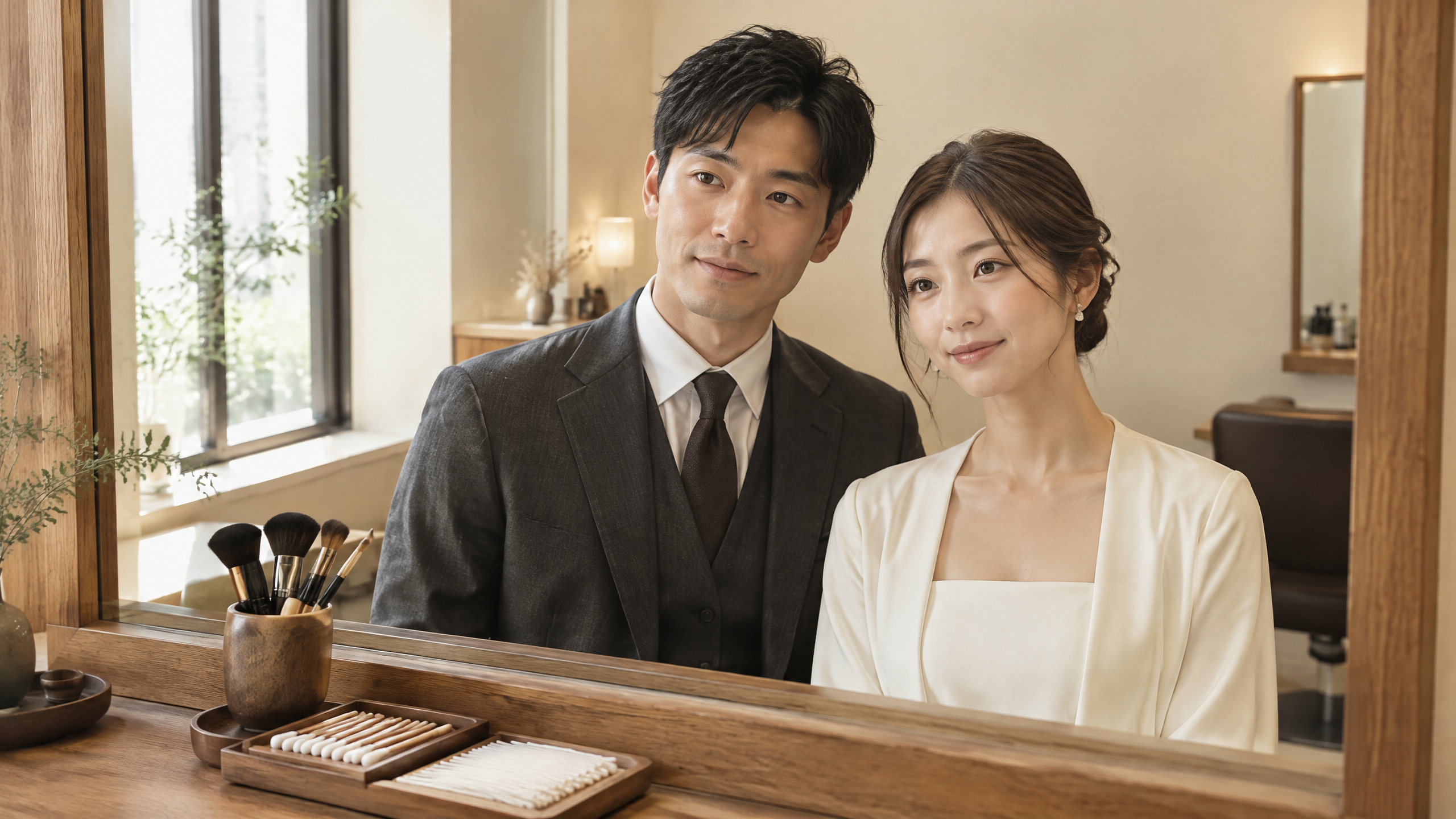
The most camera-ready groom does not look heavily made up; he looks like himself with controlled shine, deliberate hair texture and enough definition to survive changing light. Decide the hair shape first, then use restrained complexion and brow adjustments to support it, and test the complete combination under the kinds of light and movement your day will actually contain.
Wedding Morning Hair and Makeup: A Couple’s Run Sheet
The most reliable wedding morning is not one where everyone starts at the same time; it is one where each person has a clear preparation window, a defined hand-off and enough buffer before the first photograph. Build the run sheet around fixed moments, protect the groom’s haircut and grooming from last-minute experiments, and let the couple prepare in parallel whenever space and suppliers allow.
Bridal Trials and Groom Styling: Test the Whole Wedding Look
The most useful bridal trial is not a bride-only appointment: it is a controlled test of the couple’s complete visual balance. Coordinate the bride’s makeup and hair reference with the groom’s haircut, texture, facial hair and outfit, then judge the result in the lighting and photos you will actually face; this catches proportion, shine and timing problems before the wedding day.