From Hair to Makeup: Skills, Training and Credential Checks
If you already work with men’s hair, you have a useful starting point for makeup: consultation, proportion, cleanliness, timing and close observation. The right next step is not to buy every product or accept every certificate; it is to define the clients and situations you want to serve, then select training that lets you practise, receive feedback and verify what a credential actually means.
01
Start with the bridge between hair and makeup
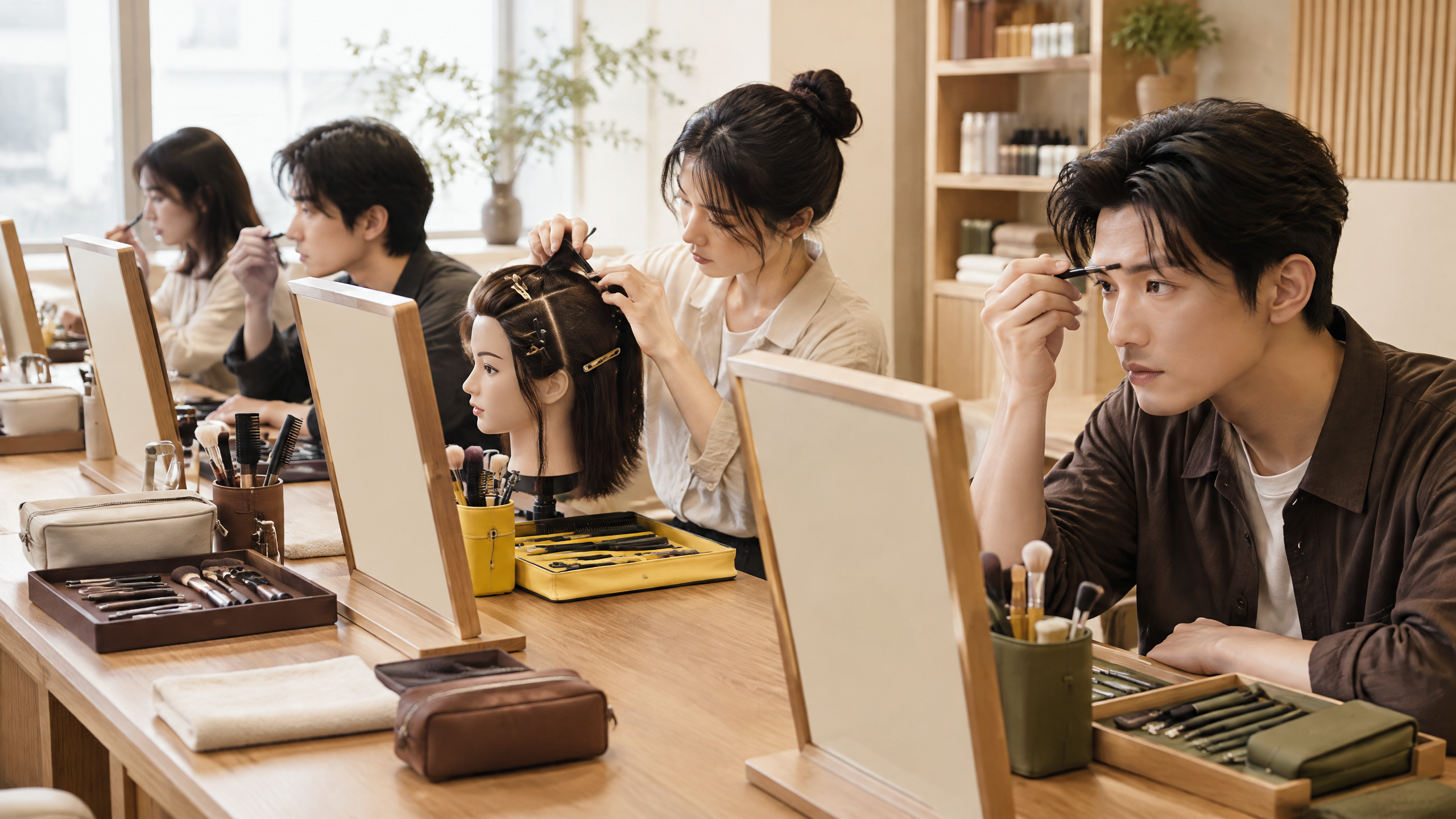
A hairstylist already reads a face in context. You assess head shape, hairline, density, texture, movement and the way a client presents himself. Makeup adds another visual layer: skin finish, eye emphasis, brow balance, lip definition and the effect of lighting. The transferable skill is not product familiarity; it is making a considered change while preserving the person’s intended image. That is particularly valuable for men who want grooming that looks polished rather than visibly theatrical.
Begin by writing down the services you can imagine delivering. A camera-ready grooming session, a wedding-party look, a stage look and a discreet complexion tidy-up have different standards. Hair work may lead you to strong consultation and finishing habits, but it does not automatically prove competence in shade selection, skin preparation, sanitation or eye-area work. Treat those as new modules to learn, not as details you can infer from cutting and styling experience.
A useful first conversation with a trainer should therefore be specific. Ask whether the syllabus covers consultation, face and colour analysis, product hygiene, preparation for different lighting, corrections, removal and adaptation for facial hair. If the page describes a basic makeup artist course, read it as a starting point for comparing foundations and practice expectations, not as proof that every possible men’s grooming scenario is included.
- List three hair services you already perform confidently and the makeup skill each one does not cover.
- Choose one client setting first, rather than promising fashion, bridal, film and daily grooming at once.
- Ask how practice is assessed and what you must bring before paying or enrolling.
02
Define a useful learning outcome before choosing a course
A course is easier to judge when the outcome is observable. “Learn makeup” is too broad; “prepare and balance a natural-looking face for a photographed business portrait” gives you a test. You can also choose an outcome such as “create a clean, durable look for a formal event while keeping beard texture credible.” These goals affect the techniques, kit, models, lighting and feedback you need.
For a working barber or stylist, schedule is part of the decision. An evening class may be convenient but may offer less model time; an intensive format may create momentum but require you to absorb many techniques quickly. Do not assume a listed duration, class size or material arrangement from a general description. Request the current written details and check whether missed practice can be replaced, whether models are provided, and whether assessment is formative or a final demonstration.
If you are considering a career change makeup course Hong Kong, compare the course’s stated starting level with your actual experience. Hair experience can make you comfortable around clients, yet you may still be new to brushes, colour correction and skin preparation. Conversely, a person with no salon background may need more time on service flow, consultation language and professional boundaries. The honest gap analysis protects both learning quality and client expectations.
| Your intended outcome | Evidence to request | Trade-off to consider |
|---|---|---|
| Natural, camera-ready grooming | Before/after practice brief, lighting guidance, feedback method | Subtle finish may require more observation than product-heavy looks |
| Event or wedding-party service | Timing drills, consultation and touch-up process | Speed can limit experimentation during class |
| Editorial or stage makeup | Creative briefs, stronger colour and removal practice | Less direct transfer to everyday men’s grooming |
| Add-on service in a hair studio | Hygiene, setup, reset and client-flow exercises | A smaller kit may mean fewer specialised effects |
03
Turn hair expertise into a deliberate practice plan
Practice should isolate decisions, not merely repeat a full face without reflection. Start with skin preparation and base placement, then practise brow balance, beard-area blending and controlled shine. Photograph work under the same neutral light where possible, noting what changed after a short break. A face can look balanced in a salon mirror but uneven in a phone camera, so review both the person’s comfort and the image’s result.
Use a simple learning log: client brief, skin or hair considerations, products used, brush or tool choice, what worked, what failed and what you would change. Do not record personal information that is unnecessary for learning. The point is to notice patterns: perhaps your base is too opaque around stubble, your brow work is too symmetrical, or your finishing spray is being used to compensate for insufficient preparation.
Set practice boundaries before inviting anyone to model. Explain that the session is training, agree on the look, allow time for removal and stop if there is discomfort. Never treat a model’s willingness as permission to improvise around the eyes or irritated skin. The FDA’s consumer guidance on using cosmetics safely advises washing hands, keeping containers clean and closed, not sharing cosmetics, and following label warnings; use that as a practical hygiene baseline, while remembering it is US consumer guidance rather than Hong Kong law.
- Practise one variable at a time: base, brows, beard-area blending, eyes or lips.
- Keep disposable applicators and a cleaning routine in the setup, not as an afterthought.
- Review photographs only with the model’s permission and store them securely.
04
Give eye and skin safety its own decision gate
Eye-area work deserves a stricter threshold than ordinary grooming. Check for visible irritation, infection or swelling and decline or postpone the service when the area is not well. Avoid sharing eye products and do not improvise with unsuitable items. Tools should be clean, and single-use applicators are a sensible control for products that touch lashes or the waterline. A confident manner is not a substitute for a safe decision.
The FDA’s eye-cosmetic guidance says not to share eye cosmetics, to use disposable tools for testing, to avoid applying eye makeup in a moving vehicle, and to stop when irritation occurs; persistent discomfort warrants medical attention 1. It also warns against using lip liner as eyeliner and against reviving dried mascara with saliva or water. These points are not a diagnosis or a Hong Kong regulatory statement, but they are useful habits to build into training and client communication.
For men’s grooming, safety also includes respect for facial hair and skin goals. A client may want redness softened without a heavy base, or may dislike product collecting in a beard. Ask what he normally uses, whether he has reacted to a product before, and what he wants to feel like when he leaves. If the request goes beyond your training, say so and refer the client to an appropriate professional rather than experimenting on his face.
05
Read certificates as documents, not promises
A certificate name can sound impressive while leaving important questions unanswered. Identify the awarding body, the training provider, the learning hours or requirements, the assessment method and the exact scope of the document. Ask whether it records attendance, completion, a practical assessment or an externally issued qualification. Those are different signals and should not be presented to clients as interchangeable.
When a course mentions a framework, funding route or named organisation, verify the claim through the relevant official source. The Hong Kong Working Family and Student Financial Assistance Agency’s Course Search Engines page provides an official way to check listed courses and advises checking the precise course name, code, provider, entry requirements, syllabus, assessment, fees and payment method 2. A private certificate name alone does not establish CEF reimbursement or HKQF recognition, and you should not infer that a provider is eligible without current confirmation.
A page comparing an HKQF makeup course Hong Kong option with other certificates can help you formulate questions, but it is not itself proof of framework status. Check the current official record and ask the provider to state exactly which organisation assesses and awards the qualification.
Make a one-page evidence file before enrolment: save the course page, request the latest prospectus, record the provider’s reply and note what the certificate can actually be used for. If the wording is vague, ask a direct question: “Who issues this document, what assessment is required, and where can I independently verify that information?” A careful answer is a positive sign; pressure to enrol before basic details are supplied is a reason to pause.
| Question | Why it matters | What to record |
|---|---|---|
| Who is the awarding body? | Separates a provider’s completion record from an external qualification | Legal or published name and verification route |
| What is assessed? | Shows whether skill is demonstrated or attendance is recorded | Practical tasks, written work, observation and pass rules |
| What does the credential claim? | Prevents overclaiming recognition or professional status | Exact wording, scope and limitations |
| Is funding or framework status current? | Listings and eligibility can change | Official search result and date checked |
06
Choose between a specialist class and self-directed learning
Self-directed practice can be efficient when you already know the basics and have a narrow goal. You can test how a lightweight base behaves with stubble, or refine a brow shape that suits a particular haircut. Its weakness is feedback: you may repeat a bias in colour, pressure or symmetry without noticing. It also makes sanitation and product selection easy to under-prioritise when there is no tutor watching the setup.
A specialist class earns its place when you need structured correction, live models, a sequence of techniques or a credible record of assessed learning. Do not select one only because its title contains “professional.” Look for the actual syllabus, practice ratio, tutor access, model arrangements and assessment. BigDeal Make Up is a related-brand resource readers may consult while comparing course information; services, classes, dates, prices and availability remain subject to written confirmation and should not be assumed from a page title.
The best route may be staged: learn core sanitation and complexion technique, practise within a defined men’s grooming brief, then add a specialist module such as bridal, photography or performance. That keeps your kit and portfolio aligned with real work instead of turning learning into product accumulation. A small, well-understood kit can be more useful than a large case you cannot explain or clean consistently.
07
Build a portfolio that shows decisions, not just finishes
A portfolio should help a prospective client understand your judgement. Include the brief, the desired level of visibility, the lighting context and the techniques you used. A close-up can show complexion and beard-area blending; a wider image can show whether makeup belongs with the hairstyle and clothing. Keep claims modest: one polished image does not demonstrate speed, consistency or suitability for every skin tone.
Ask permission before taking or publishing images, and agree on whether a face can be used publicly, privately for assessment or not at all. Avoid editing that changes the makeup result. If you are still learning, label practice work accurately and do not imply that a model was a paying client or that a school endorsed your personal service.
For a hair professional, a useful portfolio sequence might pair a haircut with three finish directions: almost invisible grooming, defined event polish and a stronger camera look. Explain the trade-off in each: coverage versus texture, shine control versus natural movement, or definition versus softness. This gives clients a reason to trust your process and gives you a repeatable consultation framework.
08
Create a realistic first-service checklist
Before accepting a makeup add-on, confirm the brief in plain language. Ask where the client will be seen, how long the result needs to last, whether photography is involved and what level of coverage feels acceptable. Confirm the hairstyle plan too: a high-shine hair finish, matte complexion and strong brows may compete, while a textured cut may benefit from more restrained face definition. The goal is a coherent appearance, not two unrelated services.
Prepare a clean station with labelled products, disposable items where appropriate, removal materials and a place for used tools. Check labels and warnings, avoid sharing products directly, and keep the client informed before working near the eyes. Never promise that a product will suit everyone or that a look will last for a guaranteed time. If timing must be estimated, state that it is a hypothetical planning example: for instance, a hypothetical 90-minute appointment might allocate 15 minutes to consultation, 25 to preparation and base, 35 to detail and 15 to review and removal; actual timing depends on the brief and the person.
Afterward, ask what felt comfortable and what should be adjusted next time. Record technique lessons, not medical conclusions. If a client reports ongoing irritation, advise stopping the product and seeking medical advice rather than diagnosing the cause. Professional restraint is part of the service, especially when expanding from hair into face work.
- Confirm the brief, setting, lighting and desired visibility before opening the kit.
- Separate clean, in-use and used tools throughout the appointment.
- Allow removal and feedback; do not treat the final photograph as the only outcome.
09
Make the next learning decision with evidence
After a few supervised or carefully documented practices, review evidence rather than enthusiasm. Which looks can you repeat? Where do you need feedback? Do clients ask for complexion work, event polish or something more creative? Your answers should determine the next course or practice block. If your work is strong in consultation but weak in colour matching, another broad beginner class may not be the most efficient choice; targeted correction could be better.
Before enrolling, compare at least two written descriptions using the same questions: starting level, objectives, model practice, hygiene, assessment, schedule, materials and certificate wording. Keep a note of unanswered items. If a provider cannot confirm current details in writing, treat that uncertainty as part of the decision, not as a promise that will be resolved later.
The aim is a sustainable extension of your grooming practice. Hair knowledge gives you an advantage in proportion, service flow and client trust, but makeup competence must be earned through deliberate technique, safe habits and honest credential language. A measured pathway will help you offer men a more coherent grooming experience without pretending that one short course—or one certificate—settles every professional question.
Sources and useful reading
Continue with hair and grooming
Explore the hair-planning side: Men's Perm Stylist Hong Kong
For another practical image-planning guide: Bridal Hair and Makeup Upskilling: Structure and Eye Detail
Meet the lead stylist and learn about the studio: Vit So and Canvas Texture
Plan your next grooming skill step
For a hair consultation, contact Canvas Texture. Share the look, setting and learning or service questions you are considering so the discussion can stay practical; any specific arrangement should be confirmed in writing.
Canvas Texture · WhatsAppFrequently asked questions
Do I need makeup experience before adding makeup to a men’s hair service?
Not necessarily, but hair experience is not a substitute for makeup training. Start with a defined outcome, learn preparation, hygiene, colour and removal, and practise with feedback before offering the service independently.
Is a makeup certificate proof that I am professionally qualified?
No. Check who issued it, what was assessed, the entry and completion requirements, and whether any claimed framework or funding status can be verified through an official source. Use the document’s exact wording rather than making broader claims.
Can I practise makeup on clients with facial hair?
You can practise only within your training and with clear consent. Learn how products interact with stubble and beard texture, keep hygiene controls, avoid irritated areas, and stop if discomfort occurs. Do not diagnose skin conditions.
How should a hairstylist choose between self-learning and a course?
Choose self-directed practice for a narrow, low-risk refinement when you can evaluate your work honestly. Choose structured training when you need live feedback, model practice, a systematic syllabus or assessment. Compare the actual learning design rather than relying on the course title.
Related journal articles
Camera-Ready Groom: Hair Texture and Natural Makeup
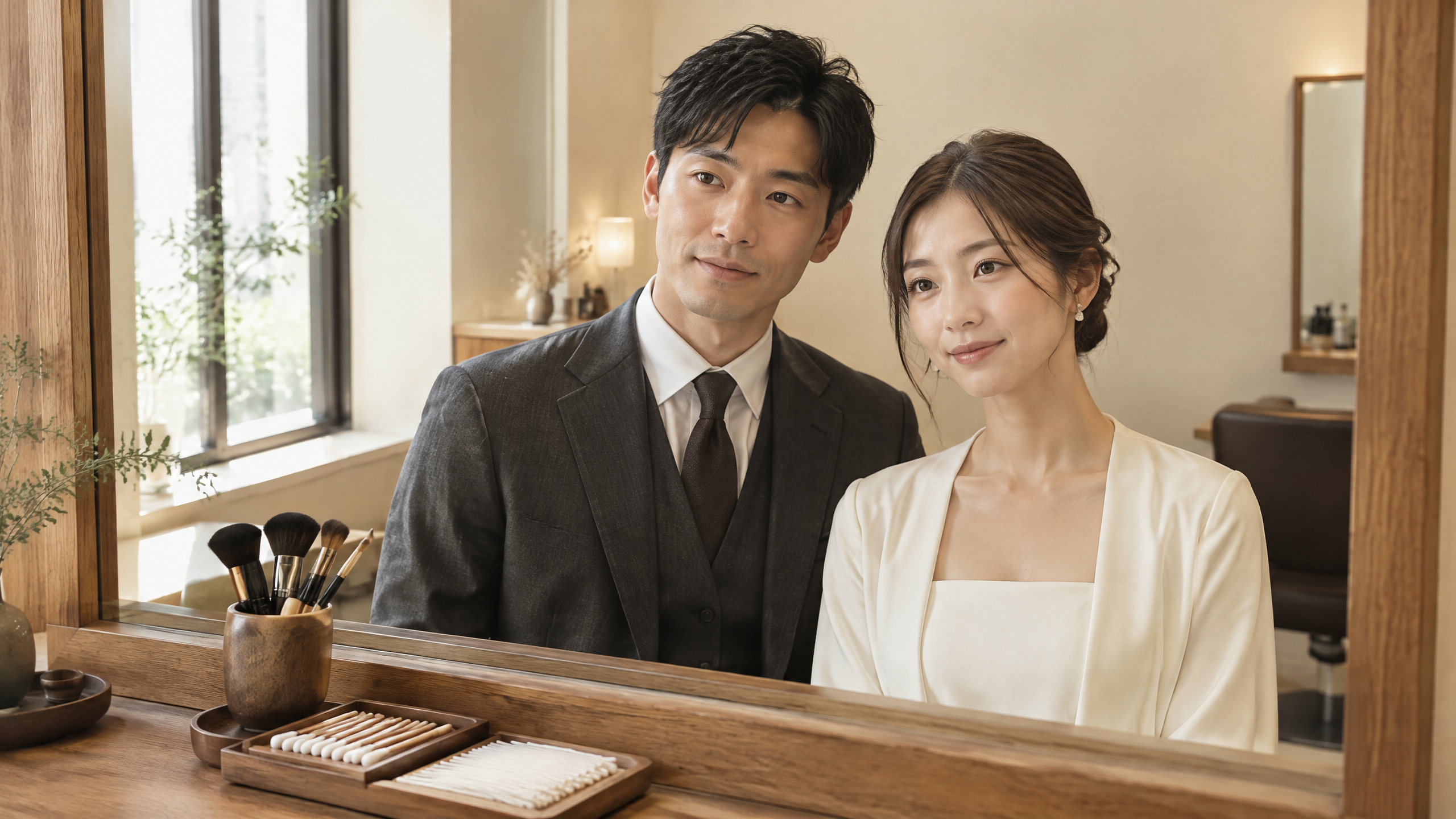
The most camera-ready groom does not look heavily made up; he looks like himself with controlled shine, deliberate hair texture and enough definition to survive changing light. Decide the hair shape first, then use restrained complexion and brow adjustments to support it, and test the complete combination under the kinds of light and movement your day will actually contain.
Wedding Morning Hair and Makeup: A Couple’s Run Sheet
The most reliable wedding morning is not one where everyone starts at the same time; it is one where each person has a clear preparation window, a defined hand-off and enough buffer before the first photograph. Build the run sheet around fixed moments, protect the groom’s haircut and grooming from last-minute experiments, and let the couple prepare in parallel whenever space and suppliers allow.
Bridal Trials and Groom Styling: Test the Whole Wedding Look
The most useful bridal trial is not a bride-only appointment: it is a controlled test of the couple’s complete visual balance. Coordinate the bride’s makeup and hair reference with the groom’s haircut, texture, facial hair and outfit, then judge the result in the lighting and photos you will actually face; this catches proportion, shine and timing problems before the wedding day.