
Flexible Scuba Lessons: Leave Time for Haircare and the Journey Home
Flexible scuba lessons can fit a busy diary, but the useful window includes changing, washing your hair and getting home, not just the lesson itself. Start with the commitments you cannot move. Then ask which training arrangements are actually available before placing a haircut, perm or colour appointment beside them. Private scheduling is an enquiry about possibilities, not a promise that every preferred date can be delivered.
For men wearing their own hair, the main styling decision is often how much work the wet-to-dry transition needs. A short textured crop, longer fringe and loose curls may need different handling after a pool or sea session. Allow time for a freshwater rinse, appropriate washing and gentle drying instead of relying on a rushed restyle at a changing-room mirror.
Canvas Texture and DiveHarbour have shared website ownership, so these links are related resources rather than independent recommendations. Canvas Texture handles men’s own-hair styling questions; DiveHarbour confirms activity eligibility, equipment and arrangements. This article is prepared by the Canvas Texture editorial team with AI assistance and public sources. It is a grooming and diary-planning guide, not diving instruction or medical advice.
01
1. Plan the whole day before choosing a private slot
Begin with your real departure and return constraints. Your work finish, travel route, changing time and next commitment all matter. Add the grooming task you actually need afterwards: simply cleaning a crop may be enough for home, whereas a longer style may need a careful dry before an important meeting. There is no universal buffer that suits every head of hair or venue. Base yours on your normal routine, then check the facilities and journey rather than assuming they will be convenient.
For the training side, DiveHarbour’s private scuba course with flexible schedule Hong Kong guide is a useful next read when fixed group dates clash with your diary. Send several possible windows and explain what cannot move. The provider still needs to check instructor, course, venue or boat arrangements and suitable conditions. A preference for individual scheduling does not establish availability, shorten learning requirements or guarantee that a practical session finishes in time for a salon visit.
Keep your hair appointment visibly separate from the activity enquiry. A dry styling consultation on another day lets you discuss your usual texture without making a wet return journey the baseline. If both must share a day, tell the salon that the earlier activity is not yet confirmed and ask about its own appointment conditions. Do not solve a tight connection by asking anyone to rush training or by planning to skip washing. Moving the less fixed commitment may be the cleaner solution.
| Possible pattern | Haircare advantage | What still needs checking |
|---|---|---|
| Private activity window on a free day | Room for an unhurried wash and dry | Actual availability, facilities and return arrangements |
| After-work session | Leaves daytime commitments untouched | Which parts run in the evening and whether washing is possible afterwards |
| Hair appointment on a separate day | Lets the stylist assess your everyday finish | Salon availability and individual chemical-service advice |
| Mixed weekday and other-day training | Allows different grooming plans for different sessions | Confirmed sequence, practical dates and written conditions |
02
2. An evening window ends after the wash, not at the pool
Evening training can look economical on a calendar while making the return home awkward. Find out which sessions involve water and which are knowledge discussions. A dry classroom evening does not require the same hair-washing plan as a pool session. Ask about the actual meeting point, expected finish and changing facilities. Facility access and closing arrangements need confirmation; neither an evening label nor a nearby map pin tells you whether a comfortable wash will be available after the session.
The weekday evening scuba course Hong Kong guide helps frame those questions without implying a current timetable. Explain when you can realistically arrive after work and when you need to be home. Ask how any separate practical days fit the plan. From a grooming perspective, an evening option only works well if you can carry your wash essentials, dry enough for your own comfort and still have a manageable journey. It should not depend on an elaborate finish in limited changing space.
Consider a hypothetical man with a longer fringe who needs a neat appearance for work the next morning. He might choose a simple clean-and-dry finish after the session, then leave detailed styling until morning. That differs from somebody heading straight to dinner, who needs enough confirmed time and facilities to finish beforehand. Neither example describes an offered slot. The point is to choose the commitment around the wash you can genuinely complete, rather than count on a bathroom you have not checked.
Count the journey to clean, comfortable hair—not just the journey to the lesson.
03
3. Give sea and pool days a straightforward wash plan
Pool chemicals and sun exposure can damage hair, and the American Academy of Dermatology recommends rinsing hair after swimming and using suitable cleansing and conditioning care.[1] Put access to freshwater on your planning list before leaving home. Ask where you can rinse after the activity and whether you need to bring your own toiletries. If facilities are limited, identify your next realistic washing opportunity rather than promising yourself a full salon-style routine in a place that cannot support one.
Choose cleansing according to your hair, the exposure and the product instructions, not a belief that the strongest shampoo must be best. Tell your stylist if your hair is coloured, lightened, permed or already feels dry, so recommendations reflect that history. A product intended for swimmers may be worth discussing, but its label does not establish suitability for every scalp. Cleaning after swimming is ordinary haircare; it is not a treatment for hair loss or a reason to dismiss persistent irritation.
Keep conditioner and styling decisions tied to where you will use them. Follow product directions and venue rules, including rules for showers and drains. Do not assume a cosmetic is appropriate to apply before entering the sea or pool simply because it sounds natural or carries an environmental claim. For the return journey, a clean, modest finish may be more practical than rebuilding a heavily styled look. You can add your usual styling later on land if your hair needs it and the setting permits it.
04
4. Separate chemical-service advice from activity approval
A new perm or colour service adds another decision to an already complicated diary. Give the stylist the proposed water dates before choosing the service, along with your existing chemical history and how often you swim. The useful conversation concerns your hair’s present condition, the intended result and the specific products being used. A fixed waiting period quoted online cannot guarantee that your individual hair will keep its colour, curl or feel after a particular pool or sea session.
Ask whether moving the chemical appointment, changing the service or keeping your existing style would better fit your plans. A conservative option may be more useful than paying for a finish you immediately put through a demanding routine. A haircut and a chemical treatment are not interchangeable decisions, either. A trim might reduce your daily styling work, but the stylist still needs to understand the shape you want and how it behaves when you let it dry with less intervention.
Hair advice cannot establish fitness for a water activity. DiveHarbour’s instructor confirms the actual course eligibility and equipment arrangements, while a clinician handles health concerns. If a scalp reaction or other symptom arises, seek appropriate clinical advice rather than covering it with product to preserve the booking. Tell the salon about relevant hair or scalp changes before a service. Keeping these conversations separate prevents an optimistic haircare recommendation from being mistaken for permission to take part in training.
05
5. Keep fringe and curls manageable without pulling harder
After washing, aim for controlled handling rather than a perfect silhouette at speed. The American Academy of Dermatology advises gentle care, avoiding towel rubbing and reducing damaging heat and tension; its detangling advice also differs for straight and tightly curled hair.[2] Press with a towel rather than scrubbing. Use a comb or brush that suits your texture, and do not treat resistance as something to force through. Ask your stylist how to adapt your familiar routine when the hair is wet and time is limited.
For a longer fringe, discuss a land-based, low-tension way to keep it out of your face while changing and travelling. Longer hair may be gathered loosely if that suits its length and condition, but a painfully tight tie is not an answer to a rushed schedule. Short hair can often be left with a simple shape rather than repeatedly combed flat. Avoid judging your haircut from one damp changing-room result; its everyday fall is easier to assess after an ordinary wash and dry.
Anything involving a mask, hood or other activity equipment belongs in a separate conversation with the instructor before entering the water. Mention hair catching or uncomfortable pulling as a concern, not as a problem to fix by altering equipment yourself. Do not assume a hair accessory will be compatible, or that a hairstyle can guarantee a seal. Your grooming goal is less unnecessary tension during ordinary handling. The equipment decision remains with the person responsible for the activity, not with a styling tutorial.
Make the hair easier to handle; do not make the equipment fit a hairstyle.
06
6. Pack for a workable return and an ordinary next morning
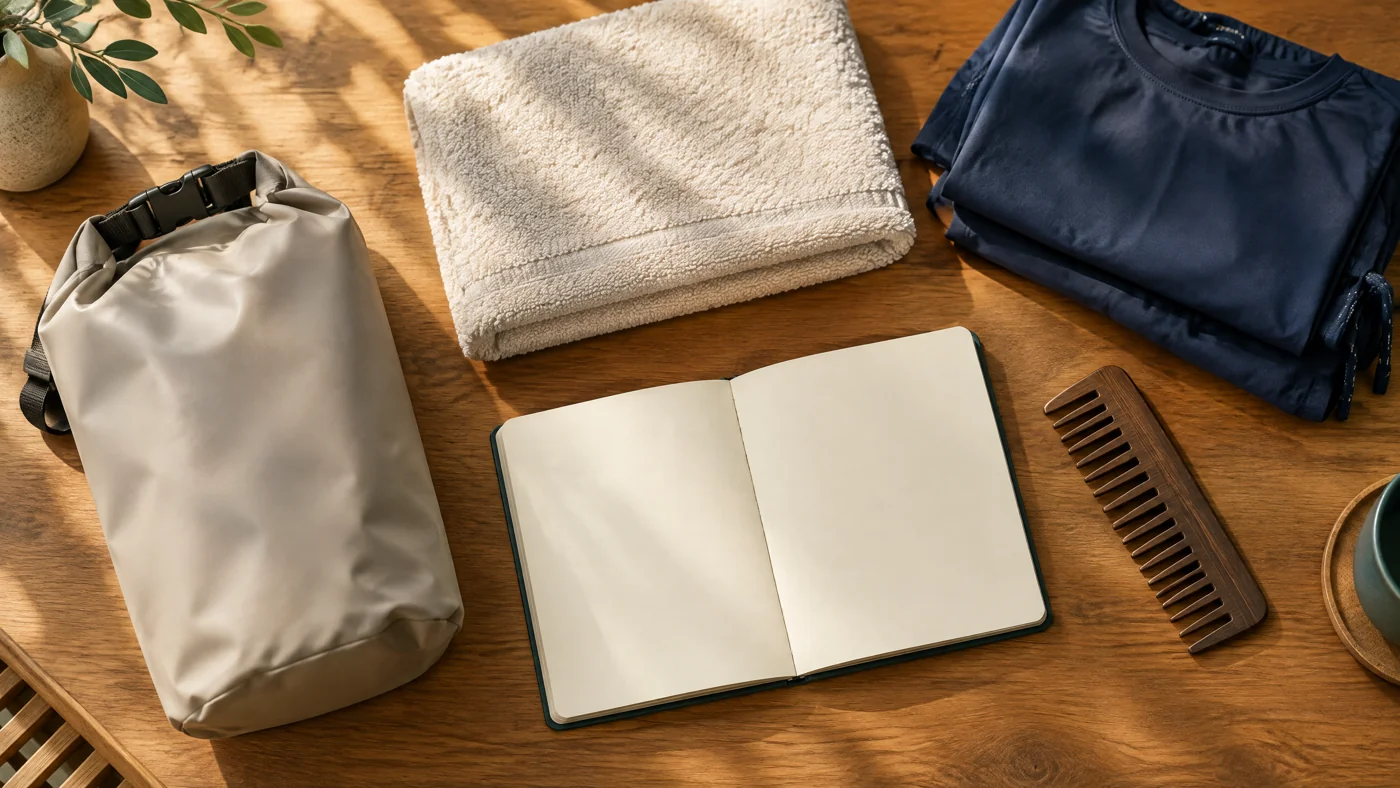
Pack a small haircare kit around confirmed facilities rather than carrying every bathroom product. Separate wet items from the towel and clothes you want clean for the journey. Bring only products you understand how to use, in suitable closed containers, and check any venue restrictions. If a drying facility matters to your plan, ask whether it is available instead of assuming one will be provided. Your bag should make the simple routine easier, not become a reason to perform extra styling after a long day.
Once home, decide what remains necessary rather than automatically repeating a complete wash already done properly at the venue. Follow the needs of your hair and the products used. If drying is needed, use lower heat and avoid pulling hard for a polished finish.[2] A style that needs prolonged hot-tool work every time you get wet may be a poor match for frequent evening sessions. Ask about a cut or everyday finish that works with your natural texture instead of fighting it on every return.
Prepare the following morning as part of the plan. Leave the tools for your normal dry styling accessible and allow your usual preparation time. If an important photograph or formal event is involved, consider separating it from an uncertain practical date rather than expecting products to restore an identical result. The sensible target is clean, manageable own hair and a realistic routine. Changes in finish can be discussed at a later salon appointment using ordinary dry-hair photographs, not a hurried judgement made on the way home.
| Item | Purpose | Practical limitation |
|---|---|---|
| Clean absorbent towel | Gentle pressing after washing | Keep it separate from wet clothing |
| Suitable cleanser and conditioner | Care matched to your hair and product directions | Use only where venue rules permit |
| Texture-appropriate comb or brush | Controlled detangling and simple styling | Avoid forcing it through resistance |
| Separate wet-item bag | Protect dry clothes and grooming tools | Unpack and clean or dry items appropriately at home |

07
7. Confirm both diaries before committing money
When you are ready to book a scuba diving course in Hong Kong, use the booking guide to organise a complete enquiry. Send your experience, course interest and possible dates, then ask for the specific arrangements in writing. Include practical constraints that affect your return, without suggesting that an appointment elsewhere requires training to end early. Confirm the meeting location and expected finish before working out the salon connection. An enquiry response is not the same as an agreed reservation.
Read the payment conditions before committing. DiveHarbour currently states that all paid fees are non-refundable and make-up sessions are available only subject to written conditions. A weather change or work conflict does not promise a replacement date that fits your hair appointment. Ask how changes will be communicated and keep the written answer with your booking record. Check the salon’s own conditions separately; shared website ownership does not merge the two businesses’ appointment systems or give Canvas Texture responsibility for activity bookings.
Finish with a plan you can follow without improvising: an agreed activity arrangement, a practical wash option, a realistic route home and an independently confirmed hair appointment if needed. If one element remains uncertain, leave that part of the diary open or reconsider the combination. Complete health information honestly and direct health questions to a clinician. Take training and equipment questions to DiveHarbour. Bring Canvas Texture the styling question that remains, such as how to make your existing fringe or curls easier to manage between water days.
- Name the date constraints that cannot move, not just your favourite slot.
- Check washing access and what you must bring before planning the return.
- Keep the provider’s written arrangements and conditions together.
- Confirm a hair appointment separately rather than treating it as part of the activity booking.
Sources and useful reading
Continue with hair and grooming
For a separate men’s own-hair discussion: Deep Hair Treatment HK
Continue with a related hair-and-water planning guide: A Week Around Water: Low-Maintenance Cuts Still Need Care
Read our hair styling background: Vit So and the Canvas Texture studio
Make your own-hair routine easier to manage
Ask Canvas Texture about men’s own-hair cuts, fringe or curl styling and everyday wash-and-dry routines that fit your diary. Direct DiveHarbour-related activity, eligibility, equipment and scheduling questions to DiveHarbour; Canvas Texture does not arrange diving bookings or provide medical advice.
Canvas Texture · WhatsAppFrequently asked questions
Does private scheduling mean I can choose any lesson date?
No. Preferred windows start an enquiry. DiveHarbour must confirm instructor, course, venue or boat arrangements and suitable conditions. Keep the related hair appointment separate until the activity details are clear.
Should I book a perm immediately before a water session?
Ask your stylist about your hair’s condition, chemical history and the products involved before deciding. There is no fixed waiting period that guarantees a retained result or establishes activity suitability. Training eligibility is a separate instructor question, and health concerns belong with a clinician.
Do I need the same haircare plan for every evening class?
No. Confirm whether the session is a dry knowledge discussion or involves water. A water session needs a realistic rinse, wash and drying plan; a dry session may only need your normal daily styling.
Can I change equipment to stop it pulling my hair?
Do not alter equipment yourself. Raise catching or discomfort with the instructor before entering the water. A stylist can help with gentle everyday hair handling, but cannot confirm equipment compatibility or guarantee a mask seal.
Will a changed activity date guarantee a make-up that fits my salon booking?
No. DiveHarbour currently states that all paid fees are non-refundable, with make-up sessions only subject to written conditions. Ask about the applicable process before paying and check the salon’s appointment conditions independently.
Related journal articles
First Scuba Lessons: Keep Your Hair, Plan the Pool-Day Wash
Keep the haircut you want to live with; prepare for the wet-hair version of it.
Trying Scuba in Hong Kong: Prepare Your Fringe Before a Mask Fitting
Prepare the fringe you actually have, not the hairstyle you hope will stay unchanged in water.
Choosing a Hong Kong Diving School: A Men's Hair Planning Guide
Choose the learning environment with the instructor; choose an achievable hair routine with your stylist.

