Hair Topper vs Wig: Where Should Coverage Stop?
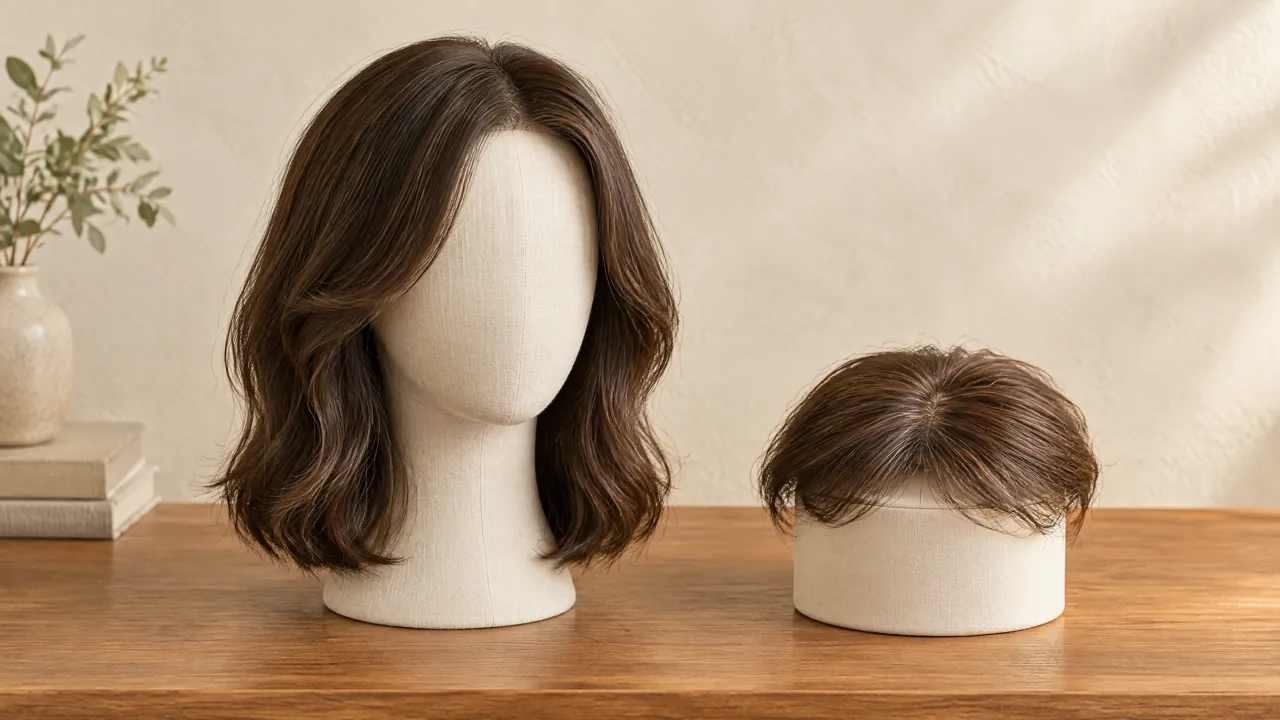
A topper is worth considering when a defined upper area needs coverage and surrounding hair can support the chosen attachment and blend. A full wig deserves comparison when several areas need coverage or blending would demand too much from your own hair. The useful boundary is not simply the visible thinning patch. It also includes the base edge, attachment positions and the transition into the hair you intend to keep showing.
Compare coverage, attachment and blending separately before choosing a size or style. A base can hide a widening part yet sit awkwardly beside a short haircut; another may cover more but place clips where the remaining hair cannot comfortably hold them. Ask to see the underside and how the proposed piece sits on your head. The hair falling from a piece may conceal an edge, but it does not extend the base beneath it.
Keep your familiar outline as the starting point, whether you are choosing for yourself or helping a partner or relative. Decide which details matter most: the part, temple shape, crown height or how the ends move. For Canvas Texture readers accustomed to discussing men's haircut proportions, this is a transferable way to approach a family member's choice. It is not a reason to impose a men's style, or to assume more coverage always looks better.
01
1. Separate the visible patch from the working boundary
Begin with two questions: which scalp areas do you want concealed, and which areas of your own hair do you want visible? A narrow part, upper crown and front hairline are different coverage problems. Mark them separately on a simple head sketch rather than calling everything 'the top'. This prevents a tempting style photograph from deciding the boundary for you. A piece that covers the crown may still leave the front unchanged, which can be either desirable or unsuitable.
The working boundary includes more than the base footprint. It must accommodate attachment points and leave enough surrounding hair for the proposed transition. With a clip-on design, ask where each clip would sit rather than assuming every perimeter position is usable. With another attachment method, request its specific fitting and removal requirements. A wider base is not automatically the answer: it may move the attachment elsewhere, but also cover hair you wanted to preserve and increase the area you must manage.
The related reading on hair topper vs wig introduces coverage, attachment and blending as separate comparisons. OwnStrand and Canvas Texture share the same owner; this is a related-brand resource, not an independent endorsement. Use the distinction to form questions rather than treat a category name as a fit recommendation. If a topper solves only one of your three concerns, keep a full-cap option in the comparison until a fitting establishes what each can realistically do.
| What you want to change | Starting comparison | Boundary question |
|---|---|---|
| A defined part or upper crown area | A suitably shaped topper | Can its edge and attachment sit beyond that area comfortably? |
| Top coverage plus a changed front hairline | Relevant topper designs and full wigs | Does this particular design address the front as well as the top? |
| Several separate areas, including sides | Full wigs alongside any plausible partial option | Would partial coverage leave disconnected transitions? |
| An all-over colour or style change | Full wigs | Can your own hair be contained without uncomfortable bulk? |
02
2. Make a coverage map before recording measurements
Look at your hair dry and arranged in the way you normally wear it. Use front, side, rear and overhead views in ordinary room lighting, then compare near a window without relying on harsh direct sunlight. A single overhead photograph can exaggerate or conceal the issue depending on the part and exposure. The purpose is to identify a consistent area you want covered, not to diagnose hair loss or produce the most alarming picture for a seller.
On your sketch, distinguish the desired coverage area from the possible attachment area. Record the front-to-back and side-to-side spans using a flexible tape, without pulling hair tight to make the measurement easier. Treat these as enquiry measurements, not a purchase-ready base specification. Head curvature, base shape and the location of fixings can change how a nominal dimension works. Ask the supplier how its measurements are taken and which orientation is shown in the product information.
Take the map to a fitting and compare it with the actual underside of the piece. Check the rear boundary as carefully as the front; crown coverage can look convincing head-on while ending too early behind the part. Avoid adding an arbitrary margin to every measurement. The fitter should explain where the base will end, where attachments will land and which hair remains outside it. Photographing the placement, if permitted, can make later positioning less dependent on memory.
Measure the area you want covered; inspect the area that must carry it.
03
3. Test the blend with the haircut you actually wear
A topper borrows the surrounding haircut to complete its outline. Compare the added hair with your own at the sides and back, not just at the part. Length, density, texture and the direction of movement all affect the join. A dense top over much lighter ends can create a shelf even when the colour is close. Conversely, thinning the added hair too aggressively may reduce the coverage you selected it for. Discuss that trade-off before any irreversible cutting.
Check the blend with your usual part and with the ordinary movements that reveal it. Turn your head, look down and gently move the hair away from the ear. If you regularly wear it tucked back, test that arrangement rather than accepting a fitting that works only with everything brushed forward. A slightly different part may help, but ask whether you would genuinely maintain it. A boundary that needs constant concealment can turn a small piece into a large daily styling commitment.
Colour matching also needs more than a shade label. Compare roots, mid-lengths and ends under more than one light, especially if your own hair has highlights or grey. Do not assume a catalogue photograph proves that a particular grey proportion or custom colour is available. Request confirmation for the proposed piece. Before changing your existing haircut, agree which lengths are needed for blending. Cutting those lengths first can remove the very bridge that made partial coverage an attractive option.

04
4. Choose the base around attachment, not area alone
Use the hair topper base size guide to separate dimensions from design. Two bases described with similar measurements can have different outlines and fixing positions. Ask for the actual shape, attachment layout and front orientation of the model under consideration. Then relate those details to your coverage map. A measurement is useful only when you know what it measures; hair length extending beyond the base should not be mistaken for additional base coverage.
During a fitting, notice what happens as the piece is secured, not only how it looks afterwards. If fastening requires pulling your own hair taut or creates a painful point, do not treat that as a necessary settling-in stage. The American Academy of Dermatology warns that repeated pulling can damage hair and that pain or stinging signals a hairstyle is too tight.[1] This supports a comfort check, not a claim that one attachment type is always safe or always harmful.
Ask for a demonstration of removal and establish how you would avoid dragging the attachment through surrounding hair. If a different fixing method is proposed, clarify the products, upkeep and any professional help it requires rather than assuming it is simpler. Repeated discomfort means the placement or approach needs reassessment, not merely a larger size. Persistent scalp irritation deserves appropriate professional evaluation. Coverage should remain a styling decision; the fitting must not become an informal diagnosis of why your hair is changing.
05
5. Give full coverage a fair comparison
A full wig reduces dependence on matching the exposed sides and back, but introduces a different fitting task. Your own hair may need to sit beneath a cap, and its length or volume can affect the result. Ask how that would be arranged without tight pulling. Check the front, temples, ear area and nape while seated and moving normally. A fuller outline can be intentional, yet unexplained bulk around the ears should not be dismissed just because the top looks convincing.
Try to compare the two categories in a similar colour and overall length when possible. Otherwise, you may prefer one dramatic hairstyle and mistake that preference for a coverage decision. First compare which option produces the outline you want with manageable placement. Then explore style variations within the stronger option. If suitable comparison pieces are unavailable, note what remains untested rather than filling the gap with assumptions from photographs or an assurance that every model fits the same way.
Cancer Research UK suggests using older photographs to communicate a familiar hairstyle and notes that fit can change when someone has hair at fitting but later loses it.[2] Bringing a photograph is therefore useful, while treating today's cap fit as permanent is not. These are general selection considerations, not evidence about a particular brand. If hair loss relates to treatment, discuss scalp sensitivity with the care team; a style comparison cannot determine which wearing arrangement is medically suitable.
| Test | What to observe | Reason to pause |
|---|---|---|
| Front, side and rear mirror views | An outline you like from every angle | The rear boundary or nape has not been checked |
| Your normal part and ear tuck | A transition that works in your usual style | The join works only in an arrangement you will not maintain |
| Gentle head turns and looking down | Comfort and placement during ordinary movement | Pulling, shifting or a pressure point |
| Placement and removal demonstration | A sequence you understand and can realistically manage | The seller cannot explain the required daily steps |
06
6. Compare a complete morning, not a mirror moment
Imagine a normal workday rather than a special occasion. With a topper, the added hair and exposed hair may need separate attention before they look like one hairstyle. With a full wig, arranging hair beneath the cap and positioning the whole piece may be the larger task. Neither category is automatically quicker. Ask to see the proposed sequence, including removal, then decide whether it matches your time, dexterity and willingness to repeat it. A helper should not be assumed available every morning.
Material and construction affect upkeep independently of coverage. Cancer Research UK distinguishes synthetic, human-hair and mixed options, and advises following manufacturer guidance when heat styling synthetic hair.[2] Ask for instructions for the exact piece rather than transferring the habits you use on your own hair. Confirm washing, drying, storage and any permitted styling tools. If you need a particular behaviour, such as restyling the part, ask for a demonstration or explicit specification instead of relying on the material name alone.
Include situations that would expose a weak boundary: carrying a bag over your shoulder, leaning forward at a desk or wearing glasses beside the ears. You need not stage a strenuous test to identify practical interference. Discuss any intended exercise or headwear separately because suitability depends on the piece and attachment. Before leaving a fitting, summarise the unresolved questions in writing. This makes it easier to distinguish a comfortable everyday option from one that looked good only while someone else arranged it.
- Describe your ordinary hairstyle and the part you will actually maintain.
- Explain any glasses or headwear that might meet the edge or cap.
- Request model-specific care and removal instructions in a form you can keep.
- List any movement, colour or fitting question that still needs confirmation.
07
7. Leave with a reasoned choice and clear specifications
If partial coverage depends on compromises you do not want, use the women's wigs page as a starting point for full-head options. Treat the page as a category guide, not confirmation that a pictured design is available or suitable. Ask which pieces can address your preferred outline and what can actually be compared. A full wig is not a failure to make a topper work; it is a different way to manage coverage and the visible transition.
Request a written description of the chosen model, material, base or cap, attachment and any proposed alterations. Clarify what the quote includes, which fitting steps are planned and the terms for changes or returns. If visiting OwnStrand, confirm arrangements for travel to its sole Kwun Tong showroom; this is not a network of district branches. Do not commit to cutting your own hair or altering a piece until you understand how those changes affect blending and what happens if the result needs adjustment.
Make the final decision by stating why coverage stops where it does. For example, a topper may preserve a favourite side shape while covering the upper crown, provided attachment and blending checks succeed. A full wig may suit someone who wants a consistent all-over outline without matching exposed lengths. Either explanation is stronger than choosing the smallest piece or the most hair. Keep the coverage map and fitting notes so future changes can be assessed against your actual priorities rather than a sales photograph.
The right amount of coverage is the amount that leaves the fewest unwanted compromises.
Sources and useful reading
Continue with hair and grooming
If your question concerns styling your own men’s hair, continue with: Korean Men's Perm
Compare a related selection decision: Bob wigs and pixie wigs: compare fringe and proportions
Read our male-hair styling background: Vit So and the Canvas Texture studio
Discuss your own haircut outline with Canvas Texture
For men's own-hair styling, speak with Canvas Texture about the shape you want to retain, including crown height, side balance and movement. Bring a familiar hairstyle photograph to help explain your preferences. This consultation concerns your existing hair and haircut, not wig sales, wig fitting or medical assessment.
Canvas Texture · WhatsAppFrequently asked questions
Does a larger topper always give a more natural result?
No. It may cover more of the desired area, but its edge, fixing positions and density still need to work with your hair. Compare the actual underside with your coverage map and check the resulting outline from the back as well as the front.
Can I order confidently from two measurements?
Two spans can help an enquiry, but they do not establish shape, head curvature or attachment suitability. Ask how the supplier measures the base and confirm the proposed design's orientation and fixing positions before treating dimensions as a fit decision.
Should I cut my surrounding hair before choosing partial coverage?
Avoid committing to a new cut before establishing the intended blend. Surrounding lengths may be needed to meet the added hair. Agree the coverage boundary and any alterations first, then assess which haircut changes genuinely help the transition.
What if a piece covers the area but feels tight?
Do not accept pain or pulling as proof of secure fitting. Pause and ask for the placement or approach to be reassessed. Persistent irritation or concern about hair loss warrants appropriate professional advice; buying coverage does not identify or treat the cause.
Related journal articles

Men’s Hairpieces or a Perm? Compare Coverage and Shape
Choose a perm when enough existing hair remains and movement is the main goal. Choose a hairpiece when a defined area needs cosmetic coverage. Neither option decides the best outline by itself. First identify the visible area, surrounding density, preferred parting, and morning routine. Those observations prevent a product label from making the decision too early. Compare those details before making any booking.
Natural Hairline Wigs: A Guide to Fringe and Forehead
Natural hairline wigs look most convincing when the front edge, fit, colour, density, and haircut agree. For a hypothetical four-day workweek side part, inspect both temples under two ordinary light sources before choosing a construction. The aim is a coherent outline in movement. No single feature can decide that outcome. Check the whole frame, not only the centre. Check it while turning your head.
Human Hair or Synthetic Wigs? Texture and Care Choices
Choose human hair when approved styling flexibility matters. Choose synthetic fibre when a preset shape and simpler mornings matter more. Neither label settles the result alone. Texture, density, cap construction, attachment, and fit shape how a wig looks and feels. Start with the routine you can maintain, then check the exact model’s instructions. That order avoids paying for flexibility you will not use