Choosing a Custom Men's Hair System: Removal and Bonding
Choose a hair system by deciding how you want to remove and maintain it, not simply how it looks. Removable and bonded arrangements describe attachment routines, but the labels alone do not explain who handles removal or what upkeep involves. Start with a realistic weekly routine, then assess the coverage and hairstyle that can work within it.
Check the actual attachment method, the condition of your remaining hair and the instructions for the particular system. A clip needs suitable hair to grip; an adhesive arrangement needs a clear removal and cleaning plan. Neither label guarantees comfort, an invisible edge or suitability for sleeping and exercise. Ask for those details before committing to a haircut designed around coverage.
For men who want to preserve a recognisable outline, the useful question is what should stay familiar: the fringe, temple shape, side length or crown height. This guide separates that styling decision from attachment and maintenance. It also offers a practical way to compare proposals without treating a hair system as a treatment for hair loss or assuming that custom manufacture settles every fitting question.

01
1. Define what removable and bonded actually mean
A removable arrangement is usually discussed in terms of the wearer taking the piece off between uses. A bonded arrangement involves adhesive attachment, but it is not permanent. Tape or adhesive can also feature in arrangements intended for frequent removal. Ask the supplier to describe the exact sequence rather than accepting two neat categories that may hide important differences between individual systems.
Write down who would detach the piece, how attachment areas would be cleaned and who would reattach it. If professional help is proposed, confirm whether it is available and what the appointment includes. Do not assume that a page explaining bonding means a business provides installation. The proposed method should be understandable even before you decide whether the finished hairstyle appeals to you.
For a starting overview, the custom men's hair system page introduces a cosmetic coverage option and points towards details to confirm. OwnStrand is a related brand under the same owner as Canvas Texture, rather than an independent recommendation. Use the information to prepare questions about your intended arrangement, not as proof that every attachment method or specification is available.
Think of removability as a practical ability rather than a sales label. Can you follow the instructed removal process yourself, see the relevant edges and store the piece safely afterwards? Could you manage the same sequence when tired or travelling? If the answer depends on another person, include that dependency in your choice rather than discovering it after a cut or purchase.
02
2. Compare routines before comparing photographs
Begin with an ordinary week, including early starts, exercise, washing and quiet evenings at home. Mark when you would prefer not to wear coverage and when you need a consistent appearance. A daily-removal routine may suit someone who values taking the piece off at home. Someone considering longer wear still needs to understand the permitted wear conditions and planned removal process.
Security is not a universal property of a category. It depends on the proposed attachment, fitting and permitted activities. Ask how the system should be checked before leaving home and what to do if an edge lifts or a clip feels loose. Swimming, helmet use and sleeping require product-specific answers; a convincing photograph cannot establish permission for any of them.
The table below compares the work involved, not which option is inherently better. Use it to identify unanswered questions in a proposal. An attachment method that looks convenient during fitting may leave you with cleaning or alignment tasks you dislike. Conversely, a method requiring planned appointments might be manageable if the arrangements are explicit and fit your actual commitments.
Make a fallback plan for the day a piece cannot be worn. This could mean keeping enough side length for an acceptable own-hair style, or choosing a fringe that still makes sense without coverage. The point is not to expect failure. It is to avoid making an ordinary maintenance day feel like a crisis because the haircut only works with the system attached.
| Routine issue | Frequently removed arrangement | Bonded arrangement under consideration |
|---|---|---|
| Taking it off | Confirm the removal steps and whether you can perform them | Confirm the removal schedule and who performs the process |
| Looking after attachment areas | Check clip placement or any adhesive cleaning requirements | Ask about the specified adhesive, cleaning and reattachment process |
| Exercise and overnight wear | Check the instructions for the individual piece | Check the instructions; bonding alone does not establish permission |
| Help and scheduling | Identify any tasks needing assistance | Confirm service availability and arrangements rather than assuming them |
03
3. Preserve a believable outline around your own hair
Coverage should answer a defined visual problem. A thinning crown, receding front and wider area of loss call for different discussions about coverage boundaries. Identify where you want added hair before choosing length or density. A full wig, a partial hairpiece and extensions are not interchangeable solutions, and the attachment discussion should relate to the proposed product rather than an appealing general description.
Bring photographs of your own familiar hairstyle, including a side view if possible. Explain which features matter most: a soft fringe, exposed forehead, flatter crown or neat profile above the ears. Pictures are a vocabulary aid, not a promise of replication. Ask which parts depend on the piece and which depend on cutting, drying or styling the hair that remains.
An exposed hairline invites close inspection of the front edge, while a forward fringe changes what is visible. Neither choice guarantees a natural result. Check the outline at conversational distance, then examine the joins more closely under ordinary lighting. Move your head rather than judging one carefully arranged angle. Compare the crown and side profile too, especially if extra height changes the proportions you recognise.
Do not trim away useful side hair before the attachment plan is settled. Some proposed arrangements may need that hair for support or blending, while others require different preparation. Discuss how the outline will change as your own hair grows between cuts. If grey blending matters, confirm the available colour mix and request a suitable sample; custom does not automatically mean every grey percentage is possible.
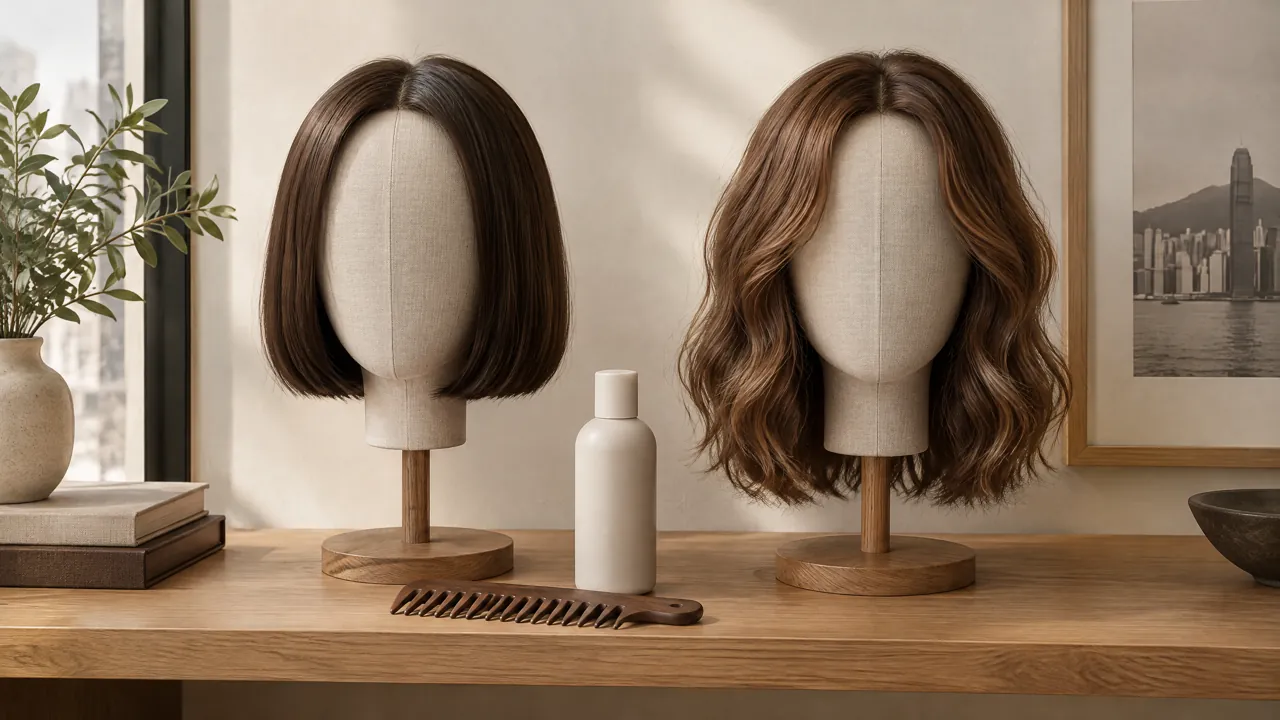
A familiar silhouette comes from the joins and proportions, not simply from adding more hair.
04
4. Turn a consultation into a specification you can check
Take a short written brief rather than a folder of unrelated inspiration pictures. Include the coverage area, preferred outline, intended removal routine and tasks you are willing to learn. Separate essentials from preferences. For example, being able to remove a piece independently may be essential, while a swept-back front is negotiable if it makes edge management harder for your proposed arrangement.
The custom wig consultation Hong Kong page describes enquiries about styles, samples and measurements before arrangements are confirmed. Ask which samples would be relevant to your coverage needs and whether they illustrate the proposed construction. A sample can help you discuss appearance, but it should not be treated as a guarantee that the final piece has identical fit or behaviour.
Request a written description covering material, construction, coverage dimensions, attachment method and the work included in fitting or cutting. Ask which details are confirmed and which depend on further assessment. For any custom order, clarify when measurements become final and what happens if your requirements change. Do not transfer a production estimate for one bespoke process to a different hair system without confirmation.
Keep manufacturing, delivery and service arrangements separate in your notes. Likewise, separate the piece itself from fitting, styling, attachment supplies and future maintenance when discussing a quotation. This is not a request for an invented all-inclusive figure. It is a way to understand what a quoted proposal actually covers and whether you must arrange any essential part elsewhere before you can use it.
05
5. Protect comfort without treating attachment as healthcare
Appearance planning and investigating hair loss are different tasks. The NHS notes that hair loss has various causes and advises medical advice when you are concerned about it.[1] A hair system offers cosmetic coverage; it does not establish why hair is thinning or make hair grow. Keep any health questions separate from the commercial decision, particularly when a change is sudden or worrying.
Remaining hair is not just a blending material. It is also affected by how an arrangement is attached and worn. The American Academy of Dermatology warns that repeated pulling can damage hair and advises against tolerating pain or irritation from tight styling.[2] That supports checking tension and discomfort, not declaring all clips harmful or every adhesive method safe. Individual assessment still matters.
During a demonstration, describe pressure, pulling or irritation precisely rather than saying only that something feels strange. Note where it occurs and whether movement changes it. Do not accept discomfort as proof of a secure fit. Stop a process that causes pain or irritation and seek appropriate assessment. A seller can explain product instructions, but should not replace medical advice about an irritated scalp.
Ask for instructions specific to the proposed base and attachment products, including cleaning, removal and situations in which wear should stop. Avoid improvised stronger adhesives or forcing a stuck area loose. If you cannot understand or perform the process, resolve that before choosing the arrangement. Comfort, correct handling and access to help belong in the decision alongside the look of the finished hairline.
06
6. Use a demonstration to test decisions, not to chase perfection
If a relevant demonstration or fitting can be arranged, agree what it is intended to establish. It may show colour, silhouette or handling without reproducing the final attachment. Ask what you are seeing before drawing conclusions. A sample that rests on the head can still be useful for proportions, but it cannot prove how a different finished system will behave throughout daily wear.
Use a decision log instead of giving the whole proposal one vague score for naturalness. Record one observation, one unresolved question and a next action for each priority. This separates a poor style match from an attachment concern or missing instructions. It also makes a second discussion more productive because you can ask for a particular adjustment rather than starting again with general uncertainty.
As an illustrative scenario, a man may like a higher crown in the mirror but notice that it makes his short sides look disconnected. He could discuss lowering the proposed volume or retaining more side length. Neither response requires changing the attachment method immediately. By separating silhouette from handling, he avoids rejecting a workable routine merely because the first styling direction was unsuitable.
Leave with permission to pause. If an important question about removal, comfort or available support remains unanswered, mark the proposal as pending rather than trying to balance that uncertainty against a flattering front view. Ask how later adjustments would be handled and which terms apply before ordering. A useful demonstration should narrow the decision; it need not produce a commitment on the spot.
| What you notice | What it may indicate | Next step before deciding |
|---|---|---|
| Front looks right but sides feel disconnected | The outline or blending plan needs discussion | Review side length and coverage boundary from several angles |
| Removal steps are unclear | The maintenance plan is incomplete | Request a product-specific explanation and suitable demonstration |
| Pulling or irritation occurs | Comfort needs assessment, not a styling compromise | Stop the uncomfortable process and seek appropriate advice |
| Sample colour differs from your own hair | Colour matching remains unresolved | Confirm available colour choices and a relevant sample |
An unanswered maintenance question is a reason to pause, even when the mirror looks convincing.
07
7. Make the final choice around a workable maintenance plan
Before comparing a removable vs bonded hair system for men, list the conditions your choice must satisfy. Include removal responsibility, care tasks, acceptable outline and arrangements for help. The comparison page is a further reading resource about attachment and upkeep questions, not proof that bonding installation is offered. Match its terminology to the actual proposal you have received rather than choosing by label alone.
If a visit is needed, plan travel to OwnStrand's sole showroom in Kwun Tong, at Room 2103, Li Bo Time Centre, 50 Hoi Yuen Road. Confirm appointment arrangements and relevant samples before travelling. Build any proposed return visits into your decision too. An attachment routine is only practical if the required help can be arranged, not simply because the first visit is convenient.
Compare material care separately from attachment care. Human hair and synthetic hair have different upkeep considerations; the NHS describes synthetic wigs as generally easier to care for and human-hair wigs as needing more attention.[1] That broad distinction does not determine which particular system fits you. Ask for its own washing, drying and styling instructions, especially before using heat or selecting a demanding daily hairstyle.
Finish with a clear reason for your choice and the conditions that would make you reconsider it. You might prioritise independent removal, or accept planned professional help if the actual arrangements are suitable. Keep the own-hair haircut plan alongside that decision so maintenance does not undermine your outline. Choosing to delay coverage while resolving questions is also a valid outcome, not a failed consultation.
- Name the person responsible for removal, cleaning and reattachment.
- Confirm instructions and activity limits for the proposed piece and attachment products.
- Agree the coverage boundary and which remaining hair should be preserved before cutting.
- Record unresolved specifications, service arrangements and order terms before committing.
Sources and useful reading
Continue with hair and grooming
If your question concerns styling your own men’s hair, continue with: Perm for Thin Hair Men HK
Compare a related selection decision: Men’s wigs: plan a workday outline rather than extra bulk
Read our male-hair styling background: Vit So and the Canvas Texture studio
Plan the outline of your own hair with Canvas Texture
For guidance on your existing fringe, side length and overall male hairstyle, arrange a Canvas Texture styling consultation. Bring familiar hairstyle photographs and explain which features of your own-hair outline you want to preserve.
Canvas Texture · WhatsAppFrequently asked questions
Does bonded mean I cannot remove the hair system?
No. Bonding describes adhesive attachment, not permanence. The appropriate removal method and timing depend on the proposed system and attachment products. Confirm who performs removal and what cleaning and reattachment involve before choosing it.
Can I choose daily removal if my side hair is sparse?
Possibly, but daily removal does not automatically mean clips are suitable. The available support, coverage area and proposed method need assessment. Ask how the piece would attach without assuming that sparse side hair can safely support every clip arrangement.
Will a custom order guarantee an invisible front edge?
No. Customisation does not guarantee a particular visual result. Confirm the construction and assess the proposed hairline, density and styling direction. A swept-back style and a forward fringe expose different parts of the front, so discuss your intended look explicitly.
Should I change my haircut before choosing attachment?
Avoid major changes to potential support or blending areas until the attachment and coverage plan is clear. Discuss which hair should be retained and how your outline can work between maintenance sessions or on days without the piece.
Related journal articles
Men’s Hairpieces or a Perm? Compare Coverage and Shape
Choose a perm when enough existing hair remains and movement is the main goal. Choose a hairpiece when a defined area needs cosmetic coverage. Neither option decides the best outline by itself. First identify the visible area, surrounding density, preferred parting, and morning routine. Those observations prevent a product label from making the decision too early. Compare those details before making any booking.
Natural Hairline Wigs: A Guide to Fringe and Forehead
Natural hairline wigs look most convincing when the front edge, fit, colour, density, and haircut agree. For a hypothetical four-day workweek side part, inspect both temples under two ordinary light sources before choosing a construction. The aim is a coherent outline in movement. No single feature can decide that outcome. Check the whole frame, not only the centre. Check it while turning your head.
Human Hair or Synthetic Wigs? Texture and Care Choices
Choose human hair when approved styling flexibility matters. Choose synthetic fibre when a preset shape and simpler mornings matter more. Neither label settles the result alone. Texture, density, cap construction, attachment, and fit shape how a wig looks and feels. Start with the routine you can maintain, then check the exact model’s instructions. That order avoids paying for flexibility you will not use