Women's wigs or toppers? Draw your coverage boundary
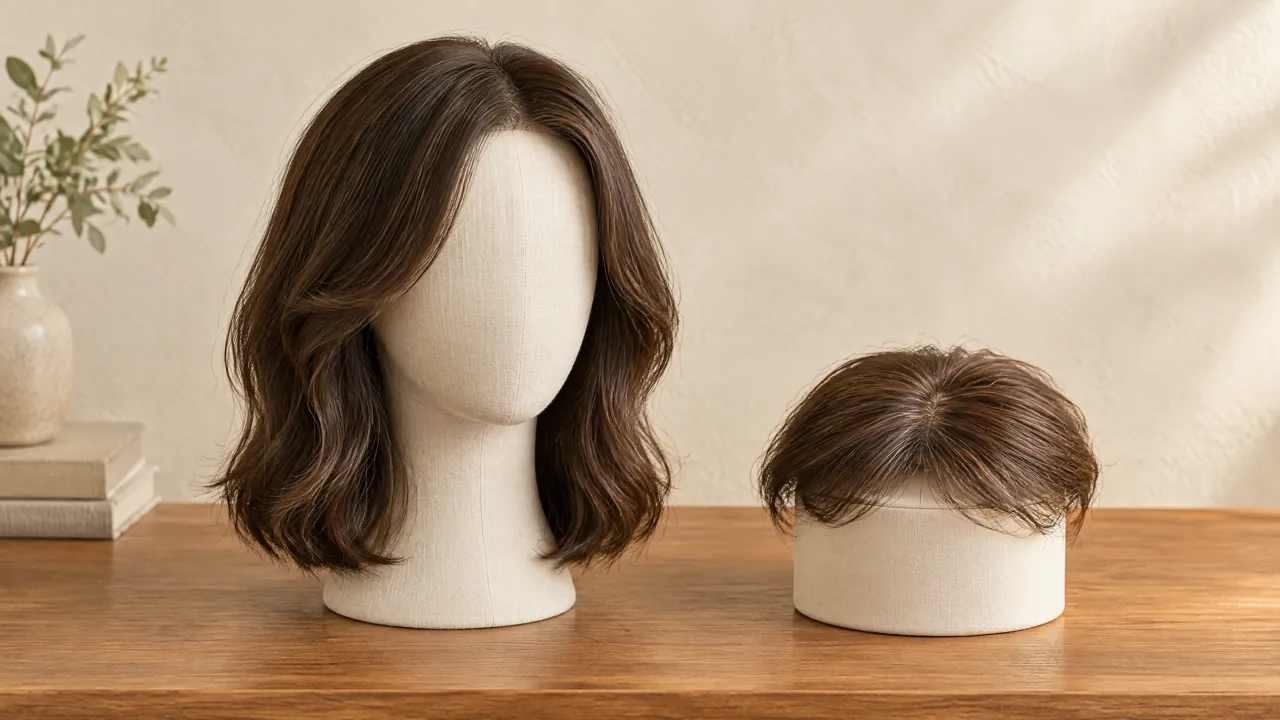
Choose a full wig when you want coverage across the whole head; consider a topper when a limited area needs covering and the surrounding hair can support the intended arrangement. The boundary matters more than the name: a small visible patch does not automatically make a small piece the right choice. Map the area you want to cover, then check where the piece would sit and how its hair would meet your own.
Compare coverage, base details and fit before choosing a colour or finished style. For partial coverage, separate the area that looks sparse from the surrounding area available for attachment and blending. For full coverage, check the front outline, sides and nape together rather than judging the fringe alone. Ask about the actual model's attachment, material and care instructions; a category description cannot establish whether one particular piece will suit your head or routine.
This is a practical appearance guide for women choosing for themselves and family members helping them compare options. It also speaks to a familiar Canvas Texture concern: keeping a recognisable hair outline when the way you style it changes. The wearer should decide what feels like her, including whether to wear a piece at all. A helper can record the questions and photographs, but should not turn fuller coverage into a goal the wearer has never asked for.
01
1. Draw three boundaries, not one bald-spot circle
Begin with your hair dry and arranged in its usual parting. In steady lighting, take a front view, an overhead view and a rear view, with help if needed. Mark three areas on a copy: the part you want concealed, the possible attachment area and the surrounding hair that must blend. These boundaries may overlap, but they answer different questions. A photograph records an appearance concern; it does not identify the cause of hair loss or determine a base size.
Draw the coverage boundary around the result you want, not only the brightest patch of scalp in one photograph. A widening part may extend towards the crown, while a fringe can hide a separate concern at the front. Compare your usual side part with any alternative you genuinely expect to wear. If moving the part exposes another area, record that too. Otherwise, a piece chosen for one carefully arranged view may demand a daily styling compromise you did not anticipate.
Full-head coverage becomes worth comparing when several visible areas need addressing or when keeping exposed hair blended would be impractical. The women's wigs page introduces that category through style and fit, rather than promising that every design solves every boundary. OwnStrand is a related brand under the same owner as Canvas Texture, not an independent endorsement. Use the page to prepare model-specific questions, then judge the whole outline rather than assuming fuller coverage must look more convincing.
02
2. Check the attachment area separately from coverage
For a partial piece, ask where each attachment point would rest relative to your coverage map. The perimeter should not be treated as a line that can simply grip whatever hair happens to be underneath. Bring your normal hairstyle into the discussion: a change of parting, a tucked side or a tied-back section may affect where attachment can sit. Ask the fitter to explain the proposed arrangement on the actual model, including any limitations, rather than relying on a generic diagram.
Comfort is a decision criterion, not an obstacle to overcome through determination. The American Academy of Dermatology warns that repeated pulling can damage hair, and that pain, stinging or scalp irritation are reasons to stop a pulling hairstyle.[1] That guidance does not prove that any particular clip, adhesive or cap is universally safe. If a trial creates discomfort, stop and have the arrangement reconsidered. Do not accept additional tension merely because it makes the piece appear flatter in the mirror.
Use the table below to identify the next question, not to diagnose your scalp or prescribe a product. A clear coverage area with an uncertain attachment area is a reason to explore alternatives, rather than automatically ordering a larger topper. Full coverage may reduce the need to blend exposed lengths, but introduces its own cap-fit and containment questions. Where the scalp is sore or changes are worrying you, keep medical assessment separate from the shopping decision; a fitting cannot establish why hair is changing.
| What your map shows | What to compare | Question to resolve |
|---|---|---|
| One localised part or crown concern | Partial coverage with a suitable perimeter | Where would attachment sit beyond the area to conceal? |
| Separate front and crown concerns | A broader partial piece and full coverage | Can one arrangement address both without an awkward outline? |
| Several areas plus limited blending hair | Full coverage alongside any workable partial option | How would remaining hair sit inside or outside the proposed piece? |
| Discomfort during the proposed arrangement | A reassessment before choosing | Which pressure or pulling point needs to change? |
A boundary that looks tidy on paper still has to feel comfortable on a moving head.
03
3. Test the join where added hair meets your own
A topper can conceal the intended area yet leave an obvious difference between its hair and the exposed lengths. Compare the join at the sides and back, not just the parting. Notice whether the two sections move together, whether the added density creates a shelf and whether the ends sit at compatible heights. A longer piece is not automatically easier to blend: it may require more cutting or styling. Ask what adjustment is proposed before deciding that a promising colour match is enough.
Write down three features of your familiar silhouette, such as a soft fringe, volume beside the temples and a tapered outline at the nape. This gives the fitting a more useful aim than copying every detail of an old haircut. Cancer Research UK suggests bringing photographs of a familiar hairstyle when choosing a wig.[2] Those photographs can also help a relative understand which details matter to the wearer. A reference photo is a conversation aid, not a guarantee that a particular construction can reproduce it.
Try the ordinary movements that reveal the join: look down, turn towards someone beside you and tuck hair behind one ear if that is your habit. View the rear outline through a second mirror or photograph. Do not have a helper continually rearrange the hair between checks; you need to see what happens without that assistance. If success depends on keeping both sides loose and motionless, consider whether that restriction fits your life. A slightly different haircut may be more workable than an exact visual copy.

04
4. Compare a partial piece and full coverage fairly
Compare both routes against the same intended result: similar length, a comparable fringe and the same everyday parting where feasible. Otherwise, you may prefer one because its haircut is closer to your taste, not because its coverage works better. The hair toppers page identifies partial coverage as a category to compare through coverage, base details and fit. It does not establish the attachment or specifications of an individual model, so keep those questions on your shortlist for confirmation.
With a partial piece, assess the work shared between the piece and your own hair. Can you arrange the exposed hair without repeatedly covering the same gap? With a full wig, assess the work involved in placing and containing your remaining hair and achieving a comfortable front-to-nape fit. Neither arrangement is inherently the simpler choice for every wearer. Record what you actually have to do during the trial, including corrections, rather than counting only the first placement as the entire morning routine.
Use a pass, revise or reject judgement for each option instead of adding everything into one impressive-looking score. Comfort and coverage should not be cancelled out by a lovely colour. Mark an option 'revise' when there is a specific question to resolve, such as adjusting the outline or confirming attachment placement. Reject it when meeting your everyday requirements depends on a restriction you cannot accept. Then compare appearance among the workable candidates; this prevents a favourite style from obscuring a basic fit problem.
05
5. Choose the routine you can repeat, not just the look
Think through an ordinary weekday from placement to removal. Include the time you spend on your exposed hair, because partial coverage does not remove that task. Someone who likes her existing lengths may welcome this shared routine; someone who wants a consistent overall outline may find it demanding. Full coverage still requires preparation, placement and care. Neither 'smaller' nor 'more complete' tells you how manageable a particular piece will be, so ask for a clear sequence rather than accepting a vague promise of easy styling.
Material changes the routine as well as the appearance. Cancer Research UK describes synthetic, human-hair and mixed options, and notes that synthetic designs often have a preset style; heat use should follow the manufacturer's guidance.[2] Do not assume that human hair means you can treat every component exactly like growing hair, or that all synthetic fibres tolerate a straightener. Ask for the actual model's washing, drying and styling instructions. Compare those instructions with the equipment and habits you are genuinely willing to use.
Separate must-have movements from optional styling ambitions. If glasses, an ear tuck or a commute are part of every day, discuss them before choosing a dramatic alternative parting for occasional photographs. Ask how to place and remove the model and whether any care products or professional adjustments are necessary. For exercise, sleeping or swimming, obtain specific guidance rather than extrapolating from a successful seated trial. An unverified activity claim should remain a question, not become the reason you select a piece.
| Your priority | Trade-off to investigate | Evidence to ask for |
|---|---|---|
| A repeatable morning outline | Preset styling versus daily blending work | The placement and touch-up sequence for the actual model |
| Frequent changes of parting | Construction may limit the intended change | A demonstration of each parting you plan to wear |
| Keeping your existing lengths visible | Partial coverage relies on a convincing join | Side and rear views without repeated rearrangement |
| Using heated styling tools | Material-specific heat restrictions | Written manufacturer instructions, not a category assumption |
06
6. Leave room for change without buying a hypothetical future
Base the first shortlist on your current coverage map, while asking what would need reassessment if your hair changed. Buying much more coverage 'just in case' can create unnecessary blending or fit challenges today. Conversely, a piece with no workable margin around the area you want concealed may leave little flexibility. Ask what changes would trigger another fitting review. Treat that answer as planning guidance, not a prediction of how much hair you will lose or a guarantee that the same piece will remain suitable.
If you try full coverage while you still have substantial hair, remember that the fit may need reviewing if that hair later changes; Cancer Research UK flags this consideration when discussing wig fitting.[2] Keep a note of how your own hair was arranged during the trial so the comparison has context. Do not interpret a later difference as proof that either the wearer or the piece is at fault. The useful question is whether the present arrangement still provides the comfort and outline you need.
Before committing, ask for the model, material, included adjustments and care requirements to be recorded alongside the quote. Clarify what is available to try, what needs ordering and what any custom request would actually include. Grey proportions, density, base construction and lead times require confirmation for that order; a general category page does not verify them. Also ask about transaction terms before alterations begin. A comparison becomes meaningful when both options describe the same scope, rather than one headline amount concealing different fitting or finishing arrangements.
Plan for a review, not for a future hairstyle you have been pressured to imagine.
07
7. Turn your coverage map into a clear next step
Finish with two realistic candidates and one unresolved question for each. For example, a partial option might need its side blend checked, while a full option might need the nape fit clarified. The hair topper vs wig guide provides further reading on coverage, attachment and blending needs. Use it to sharpen your comparison, not as a verdict on your individual fit. If neither candidate meets your non-negotiables, returning to the map is more useful than forcing a choice between them.
If planning an OwnStrand visit, confirm arrangements and the relevant samples before travelling to its sole showroom: Room 2103, Lee Bo Si Centre, 50 Hoi Yuen Road, Kwun Tong. That is a journey to the Kwun Tong showroom, not to a branch in your own district. Bring the coverage photographs, your silhouette notes and the questions that remained unresolved online. A shorter, focused list makes it easier to distinguish what the model demonstrates from what still needs checking before an order.
Let the wearer make the final judgement after seeing the front, sides and back and understanding the everyday routine. A relative can photograph the outline with permission, note answers and help resist a rushed decision. Avoid declaring that nobody will notice or that she must choose the fullest option. The practical goal is an arrangement she understands and feels willing to use. Keep this shopping decision distinct from advice about the cause of hair changes, and leave room to pause rather than purchase.
- Bring three views showing your usual parting and the area you want covered.
- Identify attachment and blending questions separately from the coverage question.
- Check ordinary movements without having someone continually reset the style.
- Record the model-specific care instructions, unresolved fit points and quote scope.
Sources and useful reading
Continue with hair and grooming
If your question concerns styling your own men’s hair, continue with: Korean Men's Perm
Compare a related selection decision: Long wigs: compare wavy and curly volume before choosing
Read our male-hair styling background: Vit So and the Canvas Texture studio
Keep a recognisable outline with your own hair
For a man's own-hair styling question, speak with Canvas Texture about the fringe, side volume and overall silhouette you want to keep. A male-hair consultation can help clarify your haircut and styling priorities; it is separate from wig shopping or medical assessment.
Canvas Texture · WhatsAppFrequently asked questions
Does a small sparse area always mean a small topper is best?
No. The area to conceal is only one part of the decision. The proposed base also needs a workable attachment arrangement and a convincing join with the surrounding hair. Compare those boundaries during a fitting rather than choosing from the visible patch alone.
Can I keep my normal side part with either type of coverage?
Possibly, but confirm it on the actual model. Ask to see the intended parting and check the front, sides and rear. A style photograph or general material description does not establish which parting changes the construction allows.
What should I do if a trial feels tight or pulls?
Stop the uncomfortable arrangement and ask for reassessment rather than tolerating it for a flatter appearance. Persistent pain, irritation or concern about hair changes deserves appropriate professional assessment; choosing coverage is not a substitute for finding the cause.
How can a family member help without taking over?
Ask which parts of the wearer's familiar outline she wants to keep, help record fitting questions and take photographs only with permission. Let her judge comfort and appearance. Support can also mean allowing her to pause or decide not to wear a piece.
Related journal articles

Men’s Hairpieces or a Perm? Compare Coverage and Shape
Choose a perm when enough existing hair remains and movement is the main goal. Choose a hairpiece when a defined area needs cosmetic coverage. Neither option decides the best outline by itself. First identify the visible area, surrounding density, preferred parting, and morning routine. Those observations prevent a product label from making the decision too early. Compare those details before making any booking.
Natural Hairline Wigs: A Guide to Fringe and Forehead
Natural hairline wigs look most convincing when the front edge, fit, colour, density, and haircut agree. For a hypothetical four-day workweek side part, inspect both temples under two ordinary light sources before choosing a construction. The aim is a coherent outline in movement. No single feature can decide that outcome. Check the whole frame, not only the centre. Check it while turning your head.
Human Hair or Synthetic Wigs? Texture and Care Choices
Choose human hair when approved styling flexibility matters. Choose synthetic fibre when a preset shape and simpler mornings matter more. Neither label settles the result alone. Texture, density, cap construction, attachment, and fit shape how a wig looks and feels. Start with the routine you can maintain, then check the exact model’s instructions. That order avoids paying for flexibility you will not use